

The Temporal Sublime
What time is it, and why does it matter?

Only by reckoning with time can we understand why the present feels simultaneously ancient, accelerated, haunted, precious, unstable, and morally urgent.
The perennial questions of who we are, why we are here, and what we should do are still with us, but as creatures vulnerable to habit and convenience, we are as likely to look for answers on our phones as in the rivers or the stars. This is still a viable, liveable, wonderful planet, and life is a great blessing. Yet many of our challenges are arguably now compounded by the way technology is reducing our capacity for attention and increasingly shaping our patterns of attachment. Our perception of the present is no longer merely informed by the deep and recent past but increasingly reconstituted by data affordances, through a predictive process that we carelessly call artificial intelligence.
Yet real intelligence, intelligence worth its salt and star dust, should be present to reality as it discloses itself moment by magical moment, and be ready to act with discernment. That intelligence says we should not despair. That intelligence says we are not wrong to love our home and seek to restore ecological sanity, not wrong to imagine that peace may be possible, not wrong to think our lives amount to more than an accident curated by an algorithm. That intelligence is available to us, and it is up to us to find it, create it, share it, and use it. Aligning ourselves with that deeper intelligence is what allows us to become and remain what Ursula K Le Guin beautifully calls realists of a larger reality.
Our sense of culmination and collapse manifests in today’s politics being exhausted by yesterday’s economics and confused by tomorrow’s technology. And that sense of incipient despair many of us sometimes feel is, I think, a recognition that the forms of hegemonic power currently shaping the world really will try to outsmart its cosmological setting, to ignore its geological condition, to outrun its imperial shadow, and further despoil its ecological inheritance. And yet, just when we most need to contend and resist, and respond from this place of expansive recoking, our epistemic commons – a fancy way to say our shared knowledge of the world and knowledge of a shared world - has been hijacked by profit-seeking algorithms, which appears to make it harder to speak truth to power, or mobilise for the greater good.
Granted, our future can sometimes seem ominous. I think it’s important not to evade that feeling too quickly because there is a certain amount of hysteresis baked in. The past is already becoming future through the present, and it loads the dice in certain ways, not least climactically. I, for one, have been tired by our drought here in London, and tempted to learn the ancient practice of rain dancing in recent days. Yet our conditions are relatively mild compared to the wildfires endured elsewhere in Europe, where the future increasingly feels more like a threat than a promise.
I see some of the spirit of our times in a line of Gandalf the Grey just after he realises the Ring of Power has been found:
You must understand, Frodo, things are now in motion that cannot be undone.
And yet, the future is not foreclosed either. Some things cannot be undone, but plenty can still be discovered, mended, created, and transformed. Rilke is also surely correct when he says:
The future enters into us, to transform itself in us, long before it happens.
And it’s not all about us either. It’s not all about our agency. There is a fair amount of happenstance, grace, luck, emergence, and it is hubris to think we can always direct the course of events, or that we should try.
So the poet Ayisha Siddiqa is also surely right when she says, wonderfully:
The future frolicks about, promised to no one, as is her right.
Lots of writers in our network are connecting the aspirational yet somewhat nebulous notion of a “transformation of consciousness” directly to a new relationship with time. This is partly why Perspectiva created a month-long inquiry into ‘temporics’ almost three years ago now, and one of many reasons why I feel a sounder grasp of the imaginal realm may matter. Time is clearly different (t)here, and Cynthia Bourgeault, for instance, suggests it may be radial and/or chiastic in highly intriguing ways. I am gradually trying to observe, experience and even inhabit time differently, so that I might communicate it better, but it’s not easy. Still, since the next instalment of my “it’s not woo if it’s true” inquiry is still brewing, and I haven’t found time to read and edit recent submissions from other authors, it seems appropriate to share some thoughts on time.
We are living through the culmination of converging historical processes in which our cosmological and geological context is becoming more salient, while our modern story of progress is unravelling. I believe what we are experiencing is less about the hollowing out of liberalism over decades and, as many others have argued, more about the mental structure of consciousness entering its deficient mode over centuries. Yet it’s all happening at the same time.
So much, so familiar. But recently, I have been feeling something new, something more specifically about time, how it is layered upon itself, and how our lives are lived at the intersections of those layers. The changes in expectation we are experiencing together are not merely historical but epochal, planetary and ontological. I have written about this before in Five Flavours of Betweeness, but I have a newfound sense of awe at the convergence of temporalities that shape our experience.
I am grateful to former Perspectiva Trustee Ian Christie for a personal communication about converging timescales that initially informed some of the thoughts above and below. As I developed the idea of converging timelines, I began to notice a connection to the sublime, which stems from thinkers like Burke and Kant and speaks to a sense of awe at the vastness of things, often with a tinge of fear, but still some sense of inspiration. The Temporal Sublime is not a new idea (unfortunately!) and has been mentioned in aesthetic theory, in literary criticism, and in historiography. For instance, it’s mentioned in a book called The Historical Sublime, by Dan Edelstein (2022) and is a subset of that.
Some of the thoughts above and below were shared on my personal Substack in February, but that already feels like a long time ago. 🙃
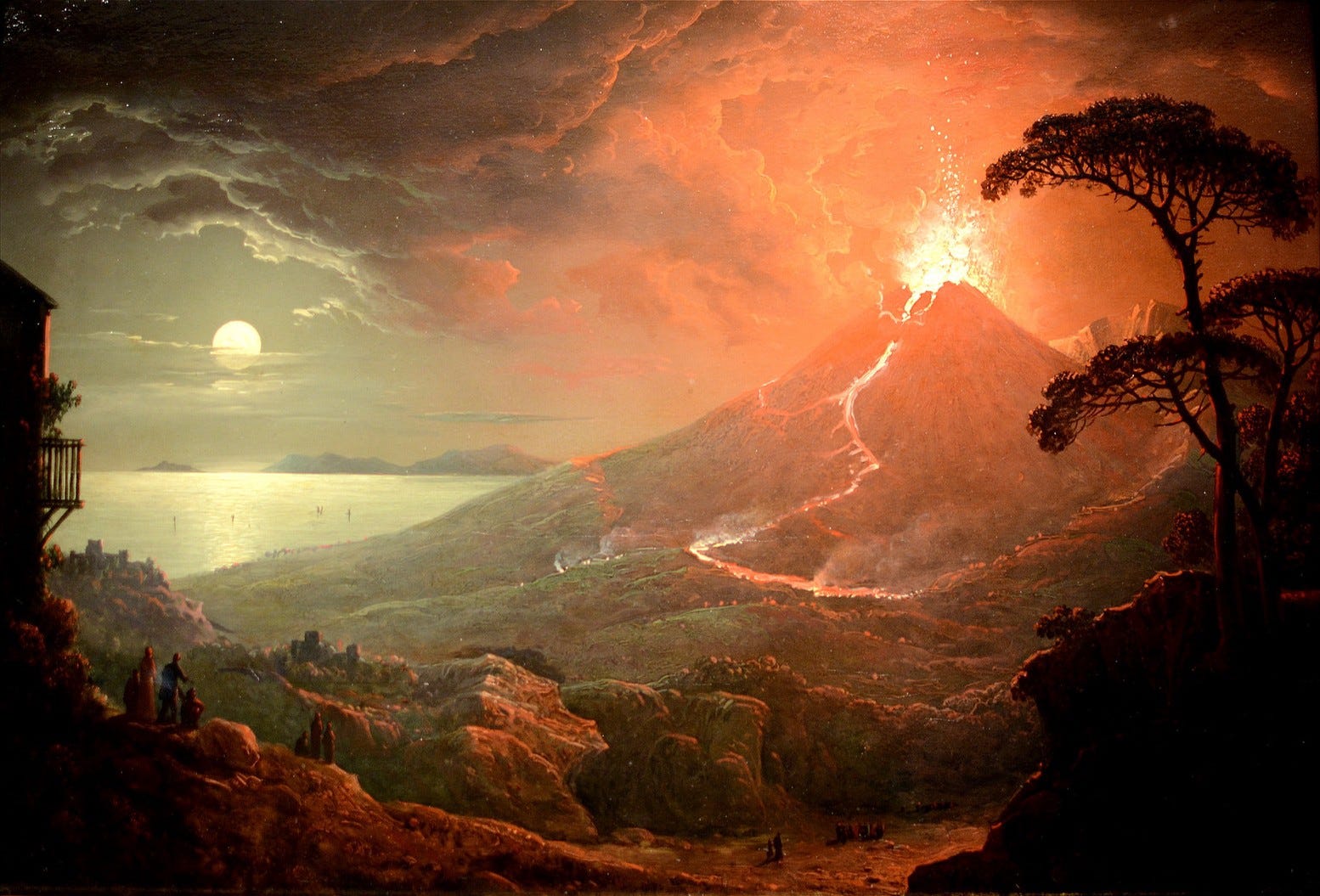

In the hum below the surface of current events is the culmination of several timescales that are now interacting with each other with potentially explosive effects, ranging from earth-system dynamics to meaning systems to political–economic regimes to neurocognitive conditions to existential orientation and spiritual temporality; considering them together helps explain why we try and fail to find any overreaction narrative for what is underway.
I can only answer the question ‘What am I to do?’ if I can answer the prior question ‘Of what story or stories do I find myself a part?’
This statement of Alasdair MacIntyre is an important touchstone for anyone asking “What can I do?” or “What should I do?”. The ‘stories’ dimension can be articulated in a range of ways, but for now I want to focus on the temporal context and setting for stories, which are also interdependent plot lines and characters of sorts. I notice them showing up in the present, and I believe, if we take time to notice, we can all find we may already have a tacit relationship to them. If we allow ourselves to feel our way into it, and seek T.S. Eliot’s ‘still point of the turning world’, the reality of these converging timescales in our lives can feel sublime.
Planetary Time: Earth is over 4.5 billion years old, and yet it sometimes feels as if we don’t realise we are living on a planet, in a solar system, in outer space, that predates us, that situates us, and should humble us. In his Pensées (1670), Blaise Pascal famously said: “The eternal silence of these infinite spaces terrifies me”, and with all due respect to Pascal, he lived long before we knew the half of it. And many feel an intellectual shift away from ‘globalisation’ to planetisation, so the next time someone tells you to get things in perspective, you could say: “I am living on a planet. How much more perspective do you want?”
Postglacial Time: At the level of Earth-systems and evolutionary time, the wider organism we are all part of, early hominins arose 6–7 million years ago, and Homo sapiens have been around since c300,000 BCE. Some believe people alive today are nonetheless feeling, at the level of species memory, the shift from the tens of thousands of years of relative Holocene stability since c9700 BCE to the volatility of the Anthropocene today, which has not been officially confirmed by geologists and goes by other names with other meanings, not least the Capitalocene (Moore) Novocene (Lovelock) and Chthulucene (Haraway). But one of the implications of geological awareness is that we are experiencing what might be considered Postglacial Time, described by Ian Christie in a personal communication as follows:
Postglacial conditions generated a variety of human predicaments that generate patterns of behaviour we can see repeated across recorded history, and which are well described in game theory and in social psychology of in/out groups, scapegoating, psychopathy and sociopathy. Zero-sum resource contests elicit violence and breakdowns of cooperation as well as promoting some actors to collaborate and innovate. Such zero-sum contests arise typically in conditions of ecological disruption (famine, plague, extreme weather, climatic shifts). To put it crudely, you don’t get the rise of Trump in positive-sum conditions, and you don’t get the triggering of violent rejection of Others unless a critical mass of people think they are in a zero-sum contest or threatened by one. To put it another way: prehistoric dispositions and pathologies of zero-sum behaviour are only lightly overlaid by post-neolithic social innovations for cooperation and learning.
Cosmological Time: As I discussed in Are we a Cow Standing on One Leg?, according to Vedic cosmology, Kali Yuga began in 3102 BCE, the fourth and worst of the Yuga cycles, marked by a breakdown in cosmic dharma. It is said to last for (just) another 426,875 years (!). This should not be taken literally, as the yugas describe divine time as much as human time, but it speaks to being ‘up against it’. Towards the end of Kali Yuga, it is said that even the concept of truthfulness will become foreign, and that is certainly how it is starting to feel today, though it may be truer(!) to say that we live in a world where the perceived need to signal tribal belonging overrides respect for evidence.
Noetic Time: The Axial Age, spanning roughly 800–200 BCE, remains the closest reference point we have for a truly profound, global shift in human consciousness, one that was co-extensive with major historical change. We may now be in the midst of a new axial age, implying a change in metaphysical orientation and an ontological shift in our relationship with the world through a new experience of time, causality and meaning; often described as a transformation of consciousness. Whether our theorist of choice is Teilhard de Chardin, Sri Aurobindo, Raimon Panikkar, Cynthia Bourgeault, Ken Wilber, Owen Barfield, or Jean Gebser, there is a strong case both that we need a new kind of mind, and that it appears to be arising (would it be rude to ask it to hurry up?). The challenge, highlighted by Sam Mickey in his wonderfully titled Co-existentialism and the Unbearable Intimacy of Ecological Emergency(2016) is that while the last Axial age converged around the arising of monotheism and individuated consciousness, there is no such fulcrum today; we appear to be in a new axial age, but without any obvious axes on which to turn.
Colonial Time: Many are reckoning with unresolved debts of injustice arising from the colonising enclosures that have a contested history and arguably go further back, but can be traced to at least England around 1500 AD and went global, including slavery, imperialism, coercion, extraction, and the enduring privileges, structures, assumptions and expectations they produced. Colonial time endures through institutions, economies, and inherited inequalities. I had a chance to ask Vanessa Andreotti and Sharon Stein about their work in this sphere, and in particular the work that ‘colonialism’ does that ‘capitalism’ does not. (Both colonial time and fossil time (next) co-arise with ‘modernity’, and the major tensions they create are part of the sense of culmination that leads some to believe modernity is dying).
Fossil Time: Humanity’s only viable habitat - Earth - is paying the price for the rapid growth of industrial civilisation enabled by coal, oil, and gas since around 1750, as fossil energy translated civilisational expansion directly into Earth-system disruption and later to the breach of planetary boundaries. We are in a time of deep dependence on fossil fuels alongside a deep need to become less dependent on them (in my first climate report back in 2013, I called this ‘stealth denial’). Almost anyone living a normal Western lifestyle is to some extent complicit in this contradiction, and we live amidst the shared sense of disavowal and dissonance.
Ideological Time: Neoliberal ideology (“the state-led remaking of society on the model of the market” - Will Davies) since around 1980 appears increasingly exhausted. More broadly, liberalism’s difficulty in narrating its own limits or transforming itself has led to increasingly desperate attempts at self-maintenance, contributing to resurgent populism, nationalism, tribalism, and authoritarianism.
Dopamine Time: The widespread adoption of social media since about 2003 and the internet-enabled smartphone becoming popular around 2010 has rapidly fragmented attention and destabilised the infosphere, while destroying the epistemic commons. The root cause of this is arguably neurochemical and addiction-forming technology.
Geocybernetic Time: There is, purportedly, a race between the USA and China to develop artificial general intelligence or otherwise to dominate artificial intelligence, and that race compresses decision cycles and raises the stakes of speed, prediction, and surveillance. We are told the race is on, and it really matters who wins, while not really understanding the stakes or what it means for us.
Astrological Time: (*I have been reading Cosmos and Psyche by Richard Tarnas and learning to see astrology archetypically.) Within astrological frameworks, Neptune (associated with dreams, dissolution, and the oceanic) moved into Aries (initiation, will, assertion) on February 20th, 2026. This transition last occurred 165 years ago and will shape the next 13 years, offering a symbolic lens on shifts in collective mood and archetypal emphasis. Some will consider this irrelevant misinformation; for others it is a really big deal.
Chiastic Time: In the work of mystic Cynthia Bourgeault, this refers to a crossed, non-linear temporality in which time is patterned with meaning, and future fulfilment reaches back to transform the past, with awakening in the present at the point of intersection, rather than at history’s end.
Now Time: In Walter Benjamin’s Theses on the Philosophy of History, Jetztzeit names not merely lived or experienced time, but time seized.
History is the subject of a structure whose site is not homogenous, empty time, but time filled by the presence of the now.
This ‘Now Time’ is the present thick with history, an interval in which action interrupts the illusion of neutral continuity. Time is neither simply given nor wholly made; it is taken up, grasped at a moment of intensity, and shaped through decisive intervention. Benjamin’s emphasis falls on historical rupture, not individual volition, and this idea can be considered alongside his famous image of the angel of history:
This is how one pictures the angel of history. His face is turned toward the past. Where we perceive a chain of events, he sees one single catastrophe which keeps piling wreckage and hurls it in front of his feet. The angel would like to stay, awaken the dead, and make whole what has been smashed. But a storm is blowing in from Paradise; it has got caught in his wings with such a violence that the angel can no longer close them. The storm irresistibly propels him into the future to which his back is turned, while the pile of debris before him grows skyward. This storm is what we call progress.
Cheery stuff.
I could add to the list, but already the culmination of timelines is a lot to take in. I share this perspective to help disabuse ourselves of the idea that things might “settle down” or that the world is just “a little bit crazy at the moment.” No. It’s altogether more difficult, alive, and generative than that.
Thank you, Jonathan. Reading this at 85, I recognise the sense of vertigo, and I'm grateful for the word "sublime", with its tinge of fear. One thing strikes me about your list: however many timescales converge, they can only reach us in one place. The present is the sole point at which any of them can touch a living person — and what arrives there is not only perspective but consequence: the soil that thins, the account that will not balance, the face opposite us that has changed. These arrive whatever our stories about them say. So I would offer a small addition to "present to reality as it discloses itself": what discloses itself most reliably is the return of what we have already done. Presence, on this reading, is not a refuge from the converging timescales but the one channel through which they can still correct us — a door, not a deckchair. Your chiastic time comes closest: awakening at the point of intersection. And perhaps the deeper intelligence you name is not something we need to find or create so much as something far older than us that we need to stop overriding. That, at any rate, is the wager of my own recent work.
Want to understand time? Check out the positions of Bergson and Kierkegaard in my article https://philaback.com/2026/07/28/either-or-space-time-resonance-presence/