


The world is in such peril that some say they can feel the ancestors waking up, imploring us to get our act together. This idea feels poetically true, and maybe even literally true in a way I cannot yet fathom. I think of my late Grandfather Rae sometimes, my mum’s dad, who looked after me when others couldn’t. When I was huddled in my bedroom around the age of eleven, playing through games from chess books for days on end, he would often peer round the door with concern and say in a thick Aderdonian dialect: “Fit wiy d’ye nae ging oot?” (Why don’t you go out?). I think of him now as one of many millions who have lived and died, as we all will, and I sometimes wonder where we go, or if we merely decompose, while enduring in fragments of memory. I am not sure why I begin here with late Grandad, Alex Rae, only that he is my ancestor, he has felt relatively close in recent months, and we need all the help we can get.
The following inquiry into communication from the near beyond, and the imaginal realm - you will have to wait for a definition - took several weeks to cook; it grew out of prior posts in this series, and it bleeds into a few more. In other words, it found its length, and that length was long, so it seemed wisest to share it in parts. This first post will be the longest, and the final edits may have their own ideas, but the menu of past, present, and likely future is this:
It’s Not Woo If It’s True 1: On the Intellectual Dignity of Believing We Are in Conversation with the World
It’s Not Woo If It’s True 2: Can we Change our Reality Settings?
It’s Not Woo If It’s True 3: Make Consciousness Great Again
It’s Not Woo If It’s True 4: Metacrisis as a spiritual injunction: Communications from the near beyond and an introduction to the imaginal realm.
It’s Not Woo If It’s True 5: Why can’t we see it? Biases of the modern mind, and different ways in: moods, poetry, freedom, mystery, images, depth, imagination.
It’s Not Woo If It’s True 6: Arabi’s similitude, Corbin’s Mundus Imaginalis, Hilman’s Soul, Gurdjieff’s Ray of Creation, and Bourgeault’s Cosmic Intertidal Zone.
It’s Not Woo If It’s True 7: What is Chiastic Agency?
These inquiries are all already published or drafted, and I’ll amble towards some generative closure in the next few weeks, but I believe each can be read on its own terms. On the Intellectual Dignity of Believing We Are in Conversation with the World, asked how the world might be if the intensely meaningful coincidences (synchronicities) most of us periodically experience are not mere accidents but part of the fabric of reality. Can we Change our Reality Settings?, considered the practice of cosmogony - the first principles evoked, instantiated and upheld through the practice of world creation. And Make Consciousness Great Again, considered what it might mean for consciousness not to be merely the guest of reality, but rather, its host.
At this halfway point, I revisit what it means for the metacrisis to be fundamentally a spiritual problem, trace how my view on that has evolved over the last decade, and, without reifying it, explain why I am now eager to understand and experience what is widely known as the imaginal realm, which can be viewed as a corollary to each of these ideas. By most accounts, the imaginal realm is the wellspring of synchronicity; it is a touchstone for cosmogonic renewal, and it is much easier to take seriously when consciousness is understood not as a thing that exists in space that emerges from matter, but as an ontological primary that only exists as time, or in time, and may well be co-extensive with a divine (sat, chit, ananda) or even a cosmotheandric (Panikkar) process.
At first approximation, the imaginal realm is the locus of the communication from the near beyond; it lies within and between material and spiritual reality as a quality of being and presence. The imaginal realm is not just a subjective state; it has its own kind of objective reality, and it is in reciprocal communication with our everyday minds and world, which are relatively unfree, yet somehow cosmically necessary. This place (that is not a place) is neither simply subjective nor objective. Depending on your metaphysical assumptions, the imaginal can be considered ‘transjective’ in nature, and it appears to be a quintessentially nondual phenomenon that can only be seen or felt through flashes of non-dual perception; flashes that stabilise into dispositions in some more than others. This intermediate zone is a substantial enough idea to appear in depth psychology (eg Hilman), Islamic and Christian mysticism (eg Arabi, Corbin, Bourgeault) and even in political theory and practice (eg Chiara Bottici).1
In the three subsequent posts, I’ll outline more precisely why it has become difficult to perceive/accept/recognise liminal noetic phenomena. Then I plunge a bit deeper into scholars and mystic practitioners who know more about the imaginal realm than I’ve forgotten, and I’ll end this series by asking what it all means for human agency in our wayward world.
I hope you find the journey worthwhile. This inquiry can be seen as an extended personal disquisition on what Jeffrey Kripal calls The Flip, and is part of Perspectiva’s overall vision and strategy to help bring into being ‘The flip, the formation, and the fun’. As you might imagine, this kind of work is difficult to fund because its impact is hard to quantify. So if you like what follows, please consider becoming a paid subscriber here, and if you are lucky enough to be in a position to make a more substantial contribution to the charity, please contact me at jonathan (at) perspectiva dot coh dot ukay.
And now, as they say: without further ado…
I think Sherlock Holmes was right. Once you’ve eliminated the impossible, whatever remains, however improbable, must be the truth. When we look at the news, it seems ever clearer that we cannot place our confidence in established institutions to do anything other than make things slightly better before they get worse again in a downward spiral, and that’s if things go well. We should not forsake our current dispensation, where we rightly tend to our figurative gardens and neighbours while seeking better governments and policies. Yet at a time of charged geopolitical entanglement, escalating warfare, incipient ecological collapse, poisoned information, technological attention and attachment hacking, ambient anxiety, and widespread governance failure, those who feel the metacrisis as their own, those who feel we are witnesses to a singular historical culmination, must look elsewhere for inspiration.
I made my peace with the improbable a long time ago. In 2013-2015, I began a tentative and enigmatic inquiry into the idea that our societal and civilisational problems are fundamentally spiritual in nature, and I have been working on that notion ever since. I began with language palatable to atheists, religious believers, and everyone in between, leading to a report and latterly a book called Spiritualise. I became a purveyor of a vanilla spirituality, prepared mostly to bring far-flung horses together (and we must not frighten the horses). That project spoke of practices and experiences - things we all do and have. I referred to love, death, self and soul - things we can all relate to. We spoke about being, belonging, becoming and beyondness - things we all feel and all aspire to.
The composite abstract noun ‘spirituality’ is nebulous; it means little in itself beyond breath and aliveness, it is always at risk of being coopted or commercialised, and by entifying itself, it arguably takes us away from what I believe to be a saner, more accurate and more generative process-relational view of the world. And so, back in the day, I used spiritual mostly as an orienting adjective to qualify a person’s outlook, disposition, or sensibility as a way to reflect interest in the kinds of issues a signpost like ‘spiritual’ might point to.
My definition, from Spiritualise (2nd edition, 2017, p17) is:
I think of spiritual sensibility as a disposition towards reality characterised by concern for the fullness of life and experienced through simultaneous intimations of aliveness, goodness, understanding, and meaning. Those glimpses of wholeness and integration have a texture that is at once emotional, ethical, epistemic, and existential – the feeling of being alive, the conviction that something matters, the intuition that the world makes sense, and the experience that life is meaningful respectively. More substantively...cultivating spiritual sensibility is about deepening our engagement with questions of being(death), belonging(love), becoming(self) and beyondness(soul).
This definition is not too shabby, and the glimpses I mention evoke the imaginal realm mentioned below, but it’s still a kind of cartological schmoozing.
In 2026, the world has changed, and atheism in theology and materialism in philosophy are by no means an intellectual default or culturally ascendant. In the second half of my life, I’m making a more fundamental commitment to act on my best guesses about the nature of reality. Today, with a bit more experience of the territory, and with less fear of being considered strange (it’s too late for that) I notice that the problem with the definition is that it’s all subjective, about (individual) experiences. These days, I feel what is needed, almost as a kind of oxygen, is to better understand the kind of reality we are collectively participating in that might give rise to our experiences, and that doing so may be a necessary part of the response to the metacrisis we are engulfed in. As a reminder, after Tasting the Pickle, here is the definition I alighted on a little later in Prefixing the World:
The metacrisis is the historically specific threat to truth, beauty, and goodness caused by our persistent misunderstanding, misvaluing, and misappropriating of reality. The metacrisis is the crisis within and between all the world’s major crises, a root cause that is at once singular and plural, a multi-faceted delusion arising from the spiritual and material exhaustion of modernity that permeates the world’s interrelated challenges and manifests institutionally and culturally to the detriment of life on earth.
If the question is: “What’s happening in the world?” The metacrisis is a good answer.
But what if the question is “What does the metacrisis ask of us?” It’s not so clear. There is the question of power and culture and technology and so on - we cannot wish that away through spiritual bypassing. And yet I think we should be equally concerned with the other kind of spiritual bypassing - not the one that bypasses political and psychological problems with escapist activity, but the one that fails to contend with the spiritual dimensions of our political and psychological plight.
So I still believe ‘we need to (re)connect with our spiritual foundations, see reality more clearly and become the kinds of people the world needs at this historical juncture’ is not bad as a provisional answer, and that’s the one I gave in 2013. I now believe that is a little too power-blind to be credible, but also that the spiritual dimension is just a little too nebulous, and that we can and perhaps should be more specific. Moreover, as I indicated in The Temporal Sublime, one way to see the metacrisis is as the convergence of multiple culminating timelines, not just the relatively proximate failure of neoliberal economics and the collapse of a liberal international order, but also the breakdown of intelligibility, a shift in cultural epoch, and even a new geological time. With all that in mind, but especially with an eye to the “transformation in consciousness” that may be required to survive the 21st century, my answer at the moment is: we need to get wiser at working with the imaginal realm.
I’ll introduce the imaginal realm in a moment, but needless to say, it is not a panacea, nor is it a place or polity as such; yet it does have potential, perspicacity, and a certain kind of power. I am focusing on it because it has helped make sense of the personal experiences I share below, and it gives ‘the spiritual’ texture, definition and scope without becoming merely wishful thinking or yet another conceptual structure. I am drawn to the imaginal realm’s illustrious intellectual history in Islamic Neoplatonism, but even more so by the sense that even if it may not be an ‘it’, it is real, that there are practices that can bring us into a wiser relationship with it, and I even wonder if it may be a kind of spiritual frontier for this historical moment. But first, I would like to share how it has shown up for me.
Clearly, the human drama does not play out on old school Earth, with Heaven and harps above and Hell and horns below. But I do believe knowing our world as a world calls for cosmological imagination, and even cosmological commitment. I cannot be sure, of course, but there appear to be realms of reality qualitatively distinct from our own that are nonetheless within reach, and that appear to want to be reached, and often reach back (though not all of them seem benign). I feel drawn into participation with this process that feels both immanent and transcendent, and it evokes for me Ursula K Le Guin’s idea of becoming ‘realists of a larger reality’.
Communications from the near beyond
I have had intimations of this kind of communication several times in my life.
I have been practising transcendental meditation most days, and typically twice a day for about thirty years. Most of the time, this is a stress-reducing and energy-giving defragmentation process, and sometimes it is choppy, even uncomfortable, with the mind full of thoughts and eager to get back to business. But other times, at least a few times a year, there is a luminous peace and clarity. At those times, I feel in touch with something like transcendental consciousness, or even that I briefly become it somehow. Others call it ‘pure creative intelligence’, and while the terms can sound nebulous, they do apply to how it feels, for instance, it’s like being “in a field of pure potentiality”. I am not saying that ‘place’ is the imaginal realm as such, just that there is at least one practice that can increase your receptivity to and appreciation of this ‘near beyond’ within minutes.
Another major portal is synchronistic experiences. For illustrations, I have grown weary of the story of Jung’s Scarab, but I have offered a few personal examples in posts relating to Parker pens, saunas, and foxes, and I trust the reader will have at least one example from their own life that comes to mind. Here is how I put it in the first post:
I have long suspected that meaning has its own ontological grooves that coexist with causation, rather than being reducible to it. In a mysterious world of processes and events, the living question for all of us is not whether or not something is a coincidence, but what is coinciding, when, and how, and why… coincidences are about the intersection of the causal and poetic orders becoming apparent to us. These kinds of encounters may even be the cosmic grammar from a mother tongue that we have forgotten how to speak, At the moment, this idea sounds niche and esoteric, but the worldview it implies is not new; but old. We have forgotten that the world speaks to us and stopped listening as if it might. It is time to start listening again.
I have also sensed this interaction sometimes when I have felt ready to consult the ancient chinese ‘book of changes’, the I-CHING, and - this is key - also when I have done so without feeling ready, and inferred prior presence through absence; there is a visceral difference in how it feels when the oracle speaks and when it doesn’t, and I believe it’s not about probability but presence (Sartre’s idea of Neant, a presence felt by its absence, might even apply). I am reminded of the sci-fi author Philip K Dick, most famous for The Man in the High Castle, which is now a (highly recommended) Netflix series. He became so curious about how the I-CHING could ‘work’ in the way it seems to, that he evoked VALIS: Vast Active Living Intelligence System. The idea is that VALIS has its own agency, but it cannot use natural language, so the deep yin/yang code and the 64 hexagrams allow for distilled symbolic communication.
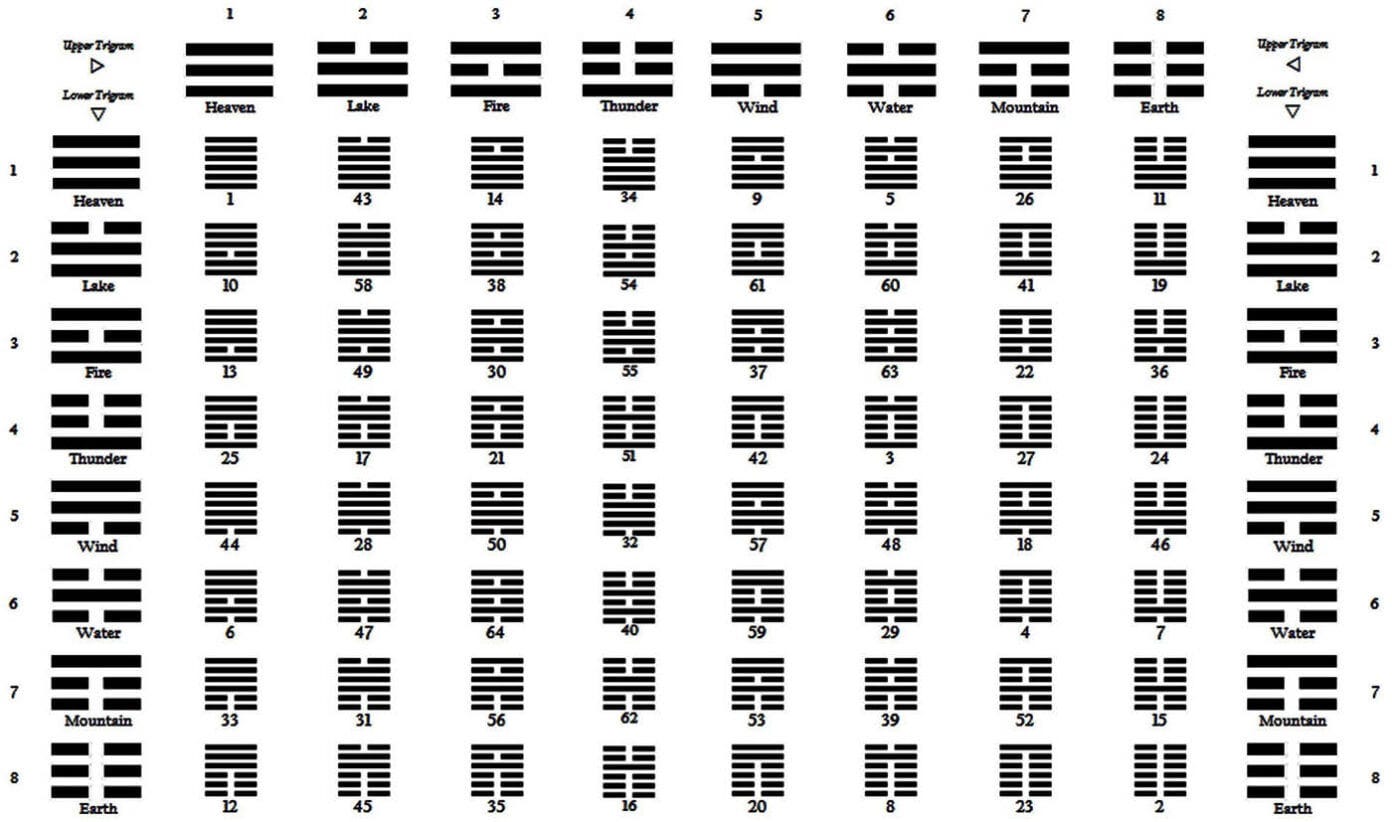
‘VALIS’ sounds too much like a robot to me to love it, but for some, a secular, cybernetic term is more palatable than what might be ‘Nous’ in Neoplatonism, or ‘Anima Mundi’ (world soul) in Jung/Pauli; and the ‘A’ in VALIS, the use of ‘active’, is pertinent. I sometimes think the ‘realm’ can also be considered a kind of valve (an opening of space) for releasing the density of energy that shapes ordinary perception, which allows our spirit to breathe more easily and our heart to see more clearly. In old theological currency, we might be in the realm of angels; in new age currency, we might be in the realm of spirit guides; in pan-indigenous language, we might even be with the ancestors. Alas, those references are culturally loaded; they risk provoking prejudice, breaking the woo-ometer, and the whole inquiry collapsing, which is perhaps partly why ‘VALIS’ was coined, and why the enigmatic nature of ‘the imaginal realm’ that I’ll come to shortly can be a form of constructive ambiguity.
I have also noticed communication from this ‘near-beyond’ in some extraordinary constellation inquiries, a technique with an ambiguous metaphysics that is becoming more popular as an away-day activity. The method is ostensibly about bodies moving around a room to inquire into the underlying relational dynamics of any given issue, but it is a kind of energy practice, and it can feel like the room not only creates a field with a mind of its own, but also thereby invites input from beyond, a kind of summoning, even, a presence that has emerged from the room and yet cannot be reduced to it. Constellations only work when people set aside their identities and opinions and surrender to their somatic and intuitive data (perhaps ‘the heart’). In a recent conversation with Nick Mayhew about constellations, he noted that insofar as encounters with the imaginal realm can be elicited, they may depend on learning “an etiquette of the heart”; and while that is an enigmatic expression, I knew what he meant.
We may have to do precisely this kind of enigmatic work to survive the 21st century. I believe we can learn to attune ourselves to the patterns of interaction disclosed through the imaginal realm more or less well, but in ways that require context and disposition to coalesce, and perhaps spiritual training to make that happen or even just to be able to allow it to happen. It’s not easy, because the phenomena in question is less like a resource that can be harvested or instrumentalised, and more like a relationship where a common language has to be learnt to deepen the relationship.
I have mentioned TM, synchronicities, the I-CHING, and Constellations Inquiry. There is, also, of course, a vast literature on religious and spiritual experiences, which have been called The Common Experience because most people have them at least once in their lives. The effect of a particularly good poem can also be a form of communication with the imaginal realm - that sense of wonder and awe that David Hinton calls ‘contact’ is a kind of interaction with the imaginal. As a final nod to encountering the imaginal, when I was in my early twenties, it was hard to deny communication with the near-beyond in two sessions with a particularly impressive psychic called Colin Grant in Edinburgh. This was in the late nineties, and I can’t remember all the details, but I know I entered the conversations sceptically, vigilant to the manipulative techniques so-called psychics often use to dupe gullible and often vulnerable people. But I was disarmed by the particularity of details of things he knew about me, and left with no doubt that what he was ‘downloading’ came from somewhere other than my words or body language.
In all cases, there is scope for scepticism and alternative explanations, but these days that feels indulgent, like an epistemic alibi I don’t need, because I’m not guilty. For me, these experiences, combined with intellectual inquiry into how they could make sense, place the idea of something beyond the veil interacting with us beyond a reasonable doubt. More precisely, while there is plenty of uncertainty over the details, this sense of other worlds intersecting or overlaid on our own is real for me beyond the polite social doubt required to avoid dogmatism or proselytising.
I felt relieved to recognise my view in a forthright statement by Gary Lachman, which is about synchronicities in particular, but applies more broadly to his work:
I am convinced that synchronicities are real, true phenomena…I have no idea how they happen nor am I convinced by any attempt so far to explain them in terms of quantum physics, as Jung and Pauli tried to do. But I am as convinced of their reality as I am that of the desk I am sitting at and the computer I am writing on. In some ways I suspect that we will never be able to explain them in any scientific way, except to say that they seem to be an experience in which what is happening in our heads and what is happening in the outside world are directly related through meaning, and that some intelligence other than our own that knows more than we do is in some way behind them. They are, I believe, related to a condition of consciousness that at present we only exprienced intermittently, but with which we will, with any luck, become more familiar.
-Gary Lachman, Lost Knowledge of the Imagination (2017 p137.)
I am intrigued by “some intelligence other than our own that knows more than we do is in some way behind them…”. That mysterious intelligence has no postcode, but many describe its abode as the imaginal realm.
I contend that unless we realise, pace Gebser, that our mental/rational function is in its deficient mode, unless we connect the unintelligibility of the world to our historical context, we will not mobilise the right kind of response. The metacrisis is the mode of reference that highlights these things because, as I argued elsewhere, the meta-move opens up the spiritual architecture of reality that is ignored or rejected by the language of polycrisis. And so today, if asked what the metacrisis asks of us, I would say it is something more like a rhetorical question.
Can we learn to better align our actions with the imaginal realm?
A tentative introduction to the imaginal realm
My impression is that the imaginal realm is a real place that is not a real place. The imaginal is both within and between our material and spiritual realities in ways that are hard to fathom. Although the ‘realm’ has no spatial extension, it has a temporal and causal reality, and that possibility is untroubling for those who can grasp that consciousness exists in time, but not in space. The imaginal realm also appears to be an abode where indwelling occurs, and that becomes credible when we discern that what dwells there are not physical entities, but something that appears to be at once personal, archetypal, normative, ideational, and agentic. This repository of virtuous form reaches us through intuitions and imagery, and these dispatches are not directives of celestial oversight from above but more like a kind of noetic solidarity, liquefactions of our collective mystical heart in the near beyond. While that heart is not a being, it is interactive and agentic Being-in-Action. Meaning arises from there, filtered through experience in patterns we can only perceive in particular ways that might best be described as chiastic, namely those myriad phenomena that criss-cross into the very centre of our lives, a centre that makes us explode with laughter and well up with tears of joy, and that is perhaps best understood as what Jean Gebser called the ever-present origin.
It is very difficult to perceive even the idea of the imaginal realm, let alone the underlying reality, due to the substance ontology that is our default mode of understanding. We are inclined to ask: what is it? And then to look for a description of something recognisable, but this approach actually precludes understanding. I detail in the next post some of the philosophical biases - analytical, empirical, presence, exterior - arising from our mental structure of consciousness that is now, many believe, in a historically deficient mode; together these biases help explain why we struggle with the idea of something real but not manifest, latent and yet present, meaningful but not causal, and that appears to ‘act’ from a non-extended place. For now, I have to trust the reader to take ‘the imaginal realm’ seriously, while not reifying it as something kind of spiritual Eldorado to seek out as a holiday destination.
That said, for those who need an image to help make sense of all these words, here is one representation of the imaginal realm as ‘World 24’ interacting with ‘World 48’ where we spend most of our time. This language comes from Gurdjieff’s Ray of Creation. I am beginning to read Gurdjieff properly now, but already I can sense that we don’t have to take this map too literally to take it seriously. The contention is that our everyday world of pizzas, pavements and parking tickets is relatively constrained by 48 rules (including laws of physics), while World 24, which Bourgeault associates with the imaginal realm, is relatively unconstrained but still somewhat constrained. As indicated, this is not about the old monotheistic properties of omniscience, omnipotence and omnibenevolence, but something very different. We might think of World 24 as another world in this world, a near-beyond where, figuratively of course, wiser siblings and cousins who may or may not be quite human hang out doing things we have not yet learnt to do. While we can’t reach them directly, we know they know us and appear to care about us, and sometimes we notice things happen in our lives that appear to come from them.
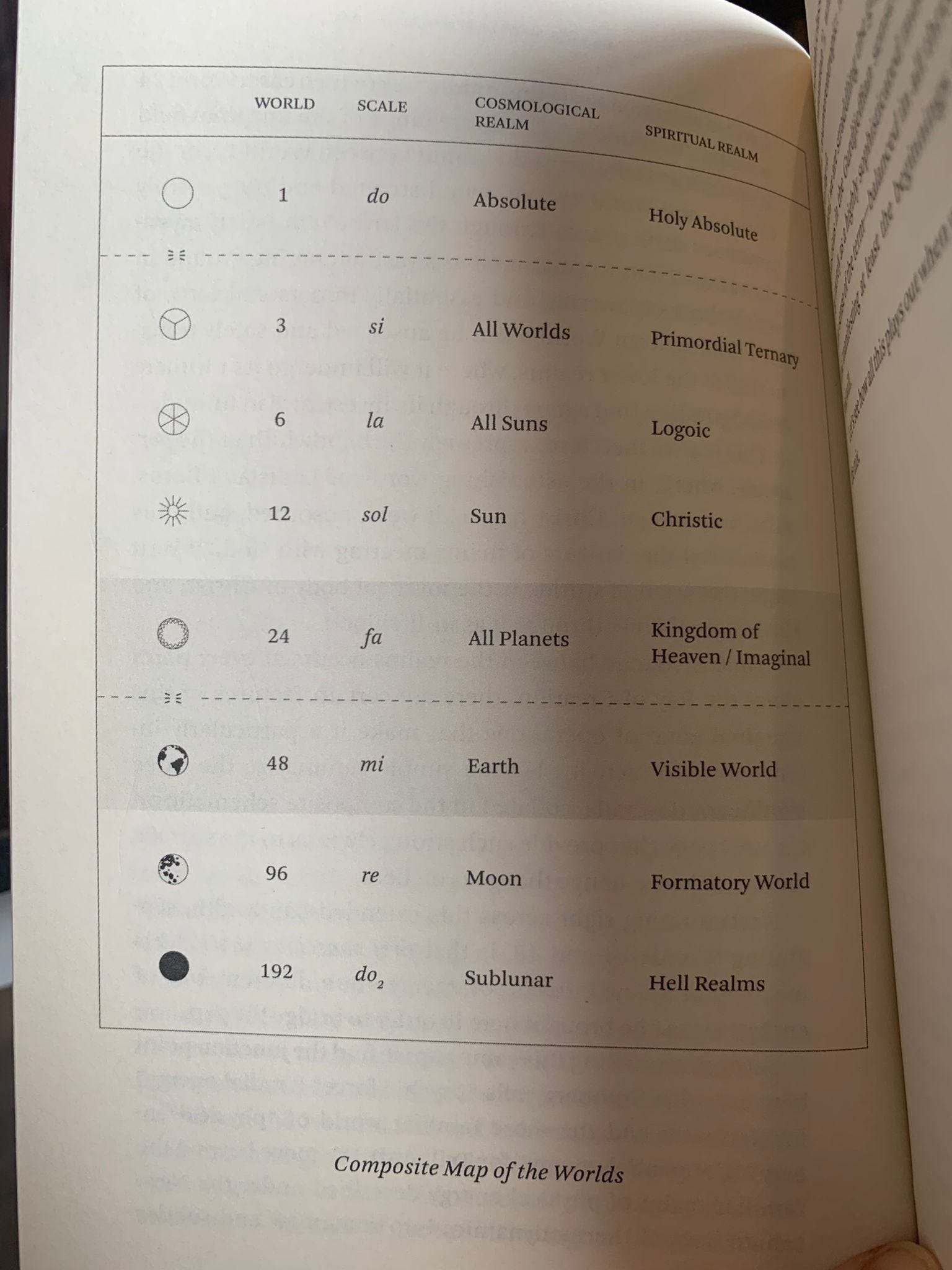
The illustration below gives some sense of why knowing the imaginal realm might matter - it is a different “density gradient” where time and causality operate differently, and in some sense better, and these different forms of time and causality interact with our own. Understanding the nature of ‘imaginal causality’ calls for a fuller vision of the self and an awareness of different kinds of time, a fuller understanding of space, and an appreciation for chiastic patterns. Again, this can feel like a stretch, but I believe it’s a good stretch towards reality rather than away from it. Another way to see it is that a great deal of what happens on Earth, ‘World 48’, happens because of ‘World 24’.
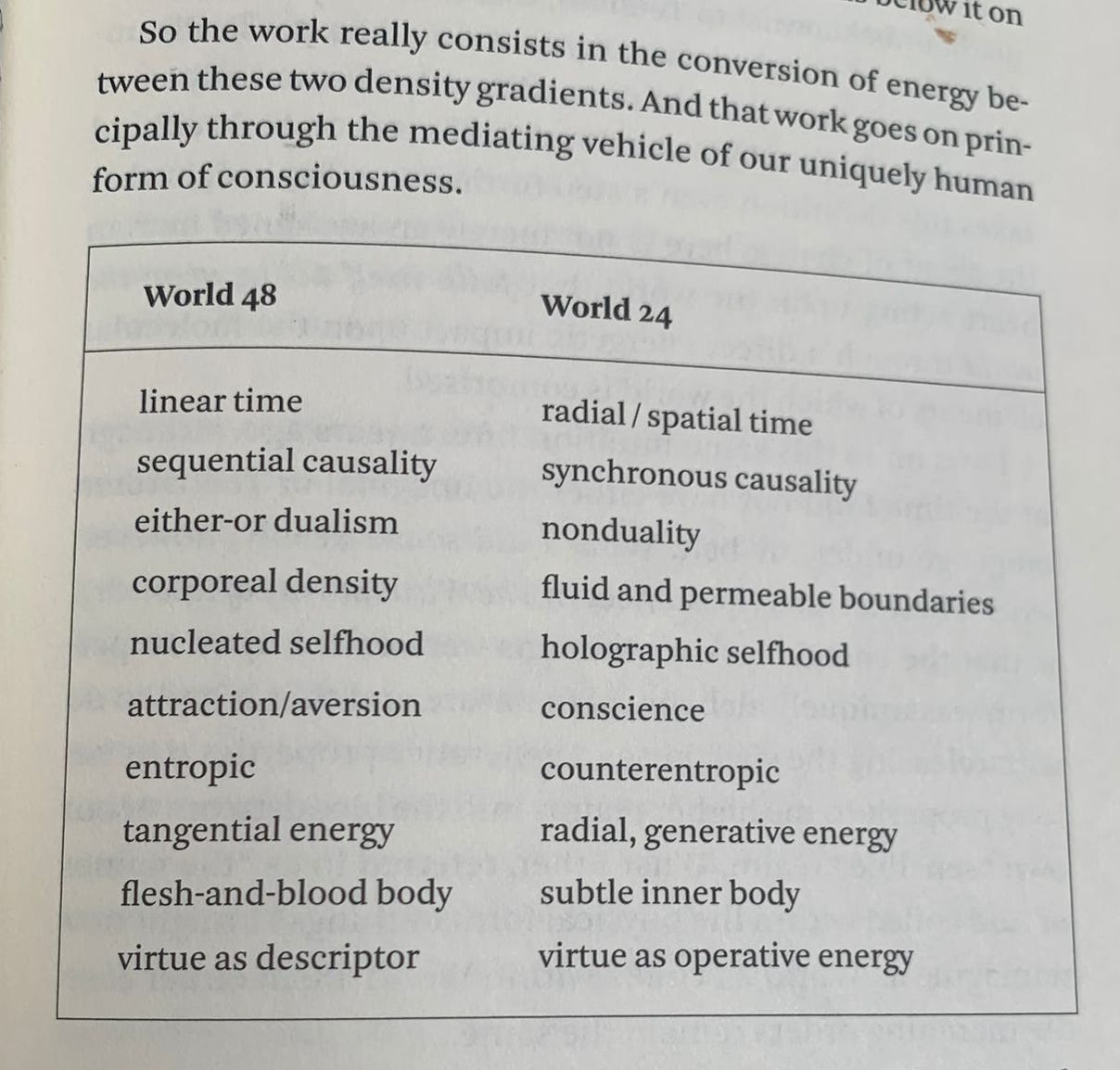
Unpacking those juxtapositions and relationships here is beyond me, but hopefully you can see not just one thing as better than the other, or even as binary opposites, both something more like the creative tension of coincidentia oppositorium (the coincidence of opposites) on a cosmic scale, the idea that these two worlds are constantly together and interacting, only that most of us rarely see or feel it.
In some sense that we can’t quite fathom, and perhaps we are not supposed to, World 24, the imaginal realm, cares about our world and is in an active relationship with it. And yet, it’s a different kind of care. Speaking personally, there is a degree of dispassion in the way this imaginal realm feels when we interact with it. My impression is that whatever preferences exist in that realm are for higher ideals, for ends rather than means. Noting Cynthia’s distinction between ‘virtue as descriptor’ and ‘virtue as operative energy’, whatever and whoever and however is there, I don’t think they care if you become a baker rather than a banker, but they may care about joy; they don’t care if you stick or quit, but they may care about courage and vitality; they don’t care if you paint your front door neon pink or royal blue, but they may care about beauty.
**
I believe it is relatively clear what the imaginal realm entails epistemologically - it’s a way of knowing from the heart, from nondual awareness, in a form of subtle but direct perception. Axiologically, it is where forms of objective value reside, where love and beauty, for instance, are even more real than they are in everyday life. Phenomenologically, we can know ‘what it’s like’ to be in some sense inside the imaginal realm when we are in certain states of non-ordinary consciousness. We can also say that the imaginal realm is temporally and aetiologically distinct, and that time and causation operate there in ways that this world needs to understand better.
However, I believe the imaginal realm is by necessity an ontological mystery. As we’ll see, some view it theologically (Arabi, Corbin, Bourgeault), others psychologically (Hilman, Jung) and some even politically (Bottici), and it’s not clear what kind of existence the imaginal realm has. I am increasingly sure there is a there there, but it’s not an object, nor any other kind of noun, and nor is there any canonical map to help us grok the territory it describes. In fact, in many ways, the constitution of our map-making minds may be the central impediment to working with the imaginal realm.
Invoking ‘the imaginal realm’ is therefore a practice of generative depth ontology as opposed to a descriptive shallow ontology. The inquiry is premised on the idea that there is more to reality than can be known through our senses (the epistemic fallacy) or constructed through our concepts (radical constructivism). Reality is a creative and relational process that we participate in, and part of what it does with us and through us is continually refashioning itself in various forms, including ideas and images.
In his classic text, Sense and Soul, Ken Wilber says that every valid form of knowledge entails an implicit injunction. Science says: Do the experiments! Maths says: Do the equations! English says: Read the books! Anthropology says: Do the fieldwork! Now, if the metacrisis is to be a valid form of knowledge, it too needs an implicit injunction.
Different theorists use their own conceptual models to describe the metacrisis and its implications. For Iain McGilchrist, it would be something like: Rebalance the hemispheres, recognise the right hemisphere’s way of attending as primary, and thereby perceive the sacred. For Stein and Gafni, in the context of their cosmoerotic humanism, the injunction is something like: Open the Eye of Value. There are many other answers to the question of what the metacris means for our reorientation.
Personally, I find the imaginal realm the most fruitful vantage point for my particular take on the metacrisis. I am interested in what we have to unlearn to perceive it, I’m curious about the socio-spiritual relationship between realms, and I like that it is a roomy enough notion, conceived of by several theorists from a range of backgrounds, to inform a way of knowing at this stage of history that feels relatively ecumenical, at a time where human survival may be at stake.
Moreover, if our shared metacrisis challenge is “a multi-faceted delusion” arising from “the spiritual and material exhaustion of modernity”, the injunctive quality of that recognition is: get beyond delusion with a new kind of wisdom, and transcend and include modernity with a new kind of mind. And a good shorthand for that is, I believe: Experience the imaginal realm.
Or, otherwise stated, in the worlds of Cynthia Bourgeault, whom I believe may understand the imaginal realm better than anyone else alive, the injunction arising from the metacrisis is that it is time to learn what it means to put the mind in the heart.
Whatever it is (and it may not be an it) do we have to call it ‘the imaginal realm’? The quick answer is no, we don’t, but there is a case for sticking with it. ‘The imaginal realm’ is an inherently confusing term for those who have not seen past the biases I will examine in the next post, so much so that it is almost a disguise, terminology hiding reality in plain sight, so that only those who are serious will search long enough to see what it actually refers to.
The first and largest problem is that ‘imaginal’ is easily confused with something made up. Second, for those who don’t make conceptual distinctions for a living, ‘imaginal’ can easily be conflated with imagination and with imaginaries, which are themselves distinct and theoretically multi-faceted. Third, even ‘the imaginal’ is somewhat contested, a moving feast, because it is theological in Henri Corbin’s ‘mundus imaginalis’, de-theologised but still ontologized in James Hillman’s take on Jung’s collective unconscious, and then de-ontologised but naturalised in Chiara Bottici’s emphasis on pictorial (re)presentations in politics. Fourth, some accounts of ‘the imaginal’ are motivated by a focus on the distinctive qualities of images qua images, while others are not, which begs the question. Fifth, it even feels misleading to speak of a ‘realm’, which has a medieval, fantasy-novel or Kingdom-like quality, and does not help people accept the contention that ‘imaginal’ is not something made-up. And sixth, the definite article ‘the’ does not help to avoid reifying this idea as a thing or place.
Nonetheless! We can sometimes love ideas because of their flaws. In this case, all the above concerns are transcended by the deep and comic irony that this kind of difficulty with the coarseness of language failing to grasp a subtler level of reality is what we would expect from…the imaginal realm. Indeed, Cynthia Bourgeault justifies her use of ‘imaginal realm’ by saying that ‘imaginal’ can unapologetically be linked to imagination as it was originally understood in its Islamic context, “namely direct perception through the eye of the heart”, and that this connects to Christian roots too. And ‘realm’ does not fundamentally mean a place, but “a set of governing laws that make possible a certain kind of manifestation.” (The Eye of the Heart, pages 4 and 5).
What I appreciate here, Jonathan, is your courage to name the metacrisis not only as systemic or epistemic, but as fundamentally spiritual, while also refusing to let “spiritual” remain vague or disembodied.
In my own work, I’ve come to see this less as a problem to solve and more as a rupture in relationship within us, between us, and among us. What you are pointing to as the imaginal realm, I recognize as a living relational field, one that becomes perceptible not only through altered states or symbolic encounters, but through the quality of attention we bring to one another and the world we share in real time. When attention widens and softens, when it becomes less instrumental and more receptive, something begins to emerge that is not reducible to an individual. Meaning, coherence, even a kind of quiet intelligence, seems to arise in the space between our perceptions and reality itself. In my language, this is the beginning of “The Communal Heart.”
If the metacrisis is, as you suggest, a misalignment with reality, then the question is how we become trustworthy participants in the relational field it discloses. For me, that begins with a simple but demanding practice of staying present, open, and grounded enough to remain in contact with myself, others, and what is trying to emerge among us.
Thank you for helping articulate this terrain with depth and sincerity.
This is very helpful and clarifying! Thank you for such precise terminology, even if both precision and terminology are provisional.
In laymans’ language it is as if there are different doors through which it is possible to access the liminal, imaginal realm, a realm of oneness (cf Richard Rohr).
One door that intrigues me (as a musician) is that of sound, both natural and composed. But it is hard to communicate how this door works without using the language of music rather than that of words to describe it.