

Why Are We Publishing a Book on Anarchism?
Pre-order There We Are Human Again, by Carne Ross, published by Perspectiva Press.


People sometimes giggle when I say I’m an anarchist. Sometimes I giggle too to make them feel more comfortable. But this is my belief to my core, now even my life’s purpose.
It’s time to declare our utopias.
- Carne Ross
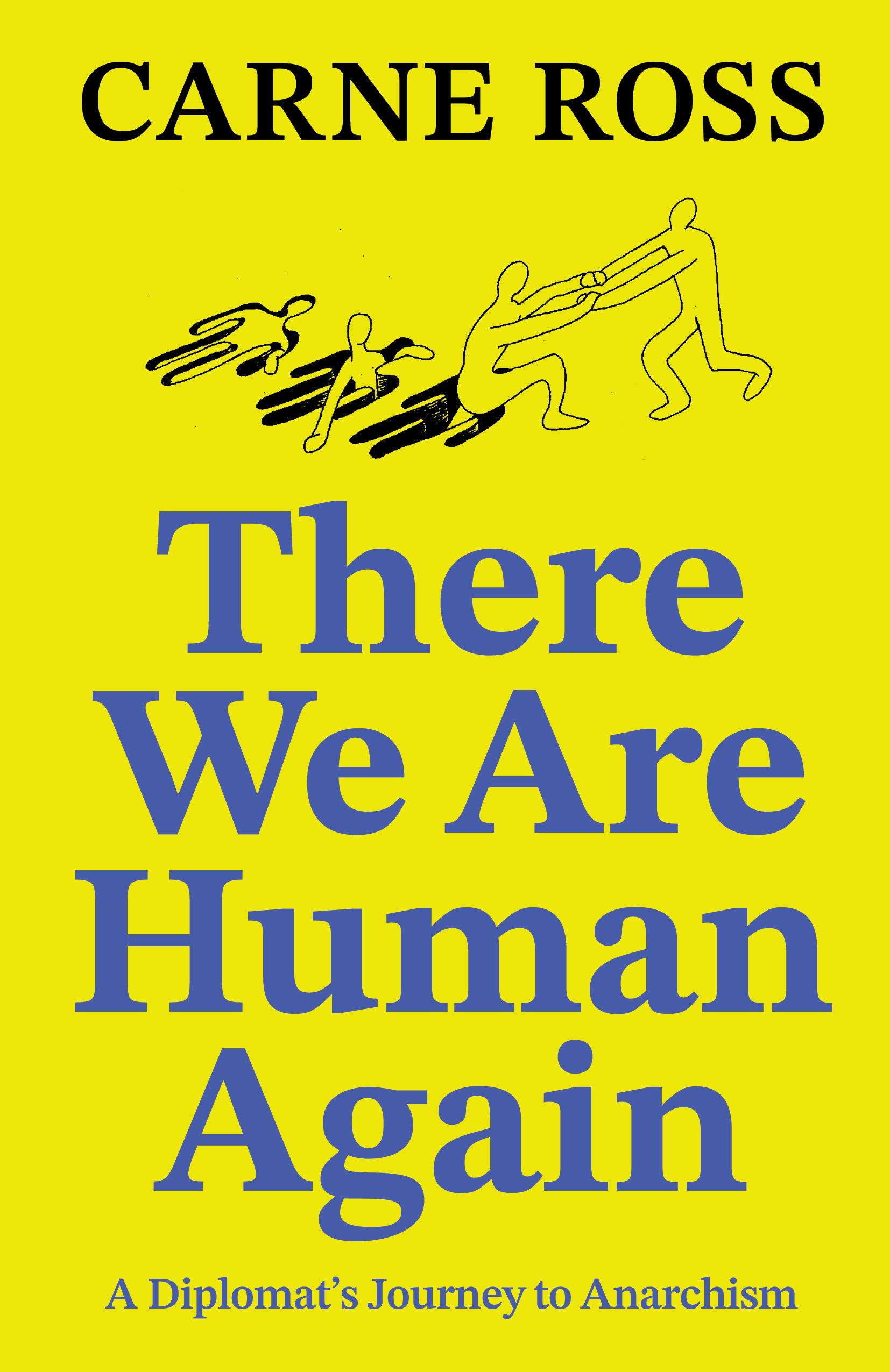
Why is Perspectiva publishing a book about anarchism?
Because it is excellent, timely, and generative.
But why anarchism?
Well, what do you think anarchism is?
I think of chaos, disorder, violence, randomness, and the breakdown of law and order.
Well, you are not alone, but that is an unfortunate misunderstanding and mischaracterisation; some would even say it’s a deliberate misrepresentation by the powerful to protect vested interests from an entirely natural phenomenon.
Anarchism is a deep belief in the human capacity to cooperate, a heartfelt commitment to democracy in its truest senses, a suspicion of illegitimate authority that rests on violence and more-or-less arbitrary coercive state power, and an understanding of the emancipatory dignity of collective agency and mutual aid.
Can you define it?
I thought I just did, but it’s not clear if definitions help. Anarchism is not one body of thought or an explicit agenda, but more like a sensibility and outlook that arises from a diverse range of sources and experiences. Leo Tolstoy was a (Christian) anarchist, Emma Goldman was a (feminist) anarchist, Mahatma Gandhi was a (anti-imperial/Hindu) anarchist, Ursula K. Le Guin was a (Taoist) anarchist, David Graeber was an (anthropologist) anarchist, and Noam Chomsky is a (linguist) anarchist. What these people have in common is a belief that the world does not have to be the way it is, and that it can and should be remade.
That’s not possible without violence! There is always a shadow side to idealism. The notion of ripping up and starting again terrifies me.
It’s not about wilful destruction, nor even starting from scratch. It’s about noticing how institutional power constrains the human spirit and our collective capacity to live well, and finding countervailing forms of power through solidarity. The Czech dissident Vaclav Havel was not an anarchist, but his famous samizdat essay - The Power of the Powerlesss - is anarchism-adjacent, and there he writes:
A better system will not automatically ensure a better life. In fact, the opposite is true: only by creating a better life can a better system be developed.
This is a variant on Buckminster Fuller’s widely quoted injunction to build a new model that makes the old one obsolete, and informs the political injunction to “invite people to a better party”. In practice that kind of purposive experimentalism can mean, for instance, withdrawing consent from unjust laws, replacing dependency on authority with mutual aid, taking decisions as far as possible outside of established structures, providing services through gift exchange, and creating new forms of cultural legitimacy through socialising good collective habits. Understood in this way, anarchism is fundamentally a praxis and a political artform, and it’s experimental in nature. It can and should be fundamentally about persuasion through a critical mass of people demonstrating another way to live.
But doesn’t it mean something like ‘rule by nobody’ - sounds like a recipe for disaster!
Well, that’s the question - why do we assume that? And is it not time to reconsider it? Anarchists are all for rules that are co-created and revisited, and also for leadership that fits contexts and purposes, not as permanent roles conferring power over others on an indefinite basis. In fact Chomsky even says (In Understanding Power 2002):
Anarchy as a social philosophy has never meant chaos - in fact, anarchists have typically believed in a highly organised society, jusy one that’s organised democratically from below.
And as for the recipe, our current recipe has led to the breaching of several planetary boundaries, genocides are underway, millions are wage slaves in some shape or form, and some believe we are on the cusp of nuclear war. Is there not already a kind of disaster unfolding?
I am not sure I would call it a disaster; any system will have its problems.
Well, yes, including anarchism - it’s no panacea and it also has its shadow; but would most people not prefer to have problems of their own making, rather than problems imposed on them by others that they have to contort themselves to adapt to? The French-Vietnamese artist Swan Dao is an anarchist, and when he is not doing handstands or singing (or perhaps especially then) he articulates it well:
Anarchists do not refuse order as such, but the established social order – an order that is regarded as fundamentally unjust, exploitative, anomic, morally debilitating, and self-alienating. It breeds conformity, indifference, and hypocrisy, and creates docile, dependent, and psychologically repressed automatons.
As you can see, for some, anarchism is more closely tied to the social and institutional constraints on spiritual awakening than to any gratuitous violence. In fact, it is more like a response to what the peace activist Galtung called structural violence.
But most people are more-or-less content and have lives worth living, and the established social order is a hard-earned achievement. Democracy, the rule of law, the free market - it’s only because of these touchstones that you can freely publish a book about anarchism without fear. Your individual freedom is more precious, precarious, and rare than you seem to realise. Historically, things have been much more chaotic and violent - try living during the Thirty Years' War before The Treaty of Westphalia - states and boundaries are part of peace, and I would not want to wish away the order we have achieved - I think we might soon want it back.
Ok, I can certainly grant that the state is not always bad, and rules are sometimes helpful. But given the state of the world, imagine instead we were publishing a book about the wisdom of the state and the kindness of capitalism, and why the future depends on state-led capitalism - would that seem like a good idea?
No, though you are caricaturing things there a bit.
And what of state-led socialism? Would that be your cup of tea?
No, but…
And you know that at least until recently, and still to a large extent, we have been living under neoliberalism as the prevailing orthodoxy on political economy? Two of the best short definitions of neoliberalism are both by Will Davies: “The disenchantment of politics by economics”, and “the state-led remaking of society on the model of the market”.
What’s your point?
The political and economic orders are inextricably linked, and anarchism serves this moment well by drawing attention to the common factor - the state-led bit. That point applies to the way that the state today is so closely aligned with techno-capital power in many places while being unable or unwilling to create transformative economic change. I am intrigued by anarchism because, among political philosophies, it’s the only one that says our biggest problem may be hiding in plain sight.
Sounds a bit too high level, abstract…
Is ‘the state’ abstract? Maybe, but it’s a root cause we need to consider. And whether you accept the arguments or not, you will be familiar with the idea that the fundamental driver of many social and ecological ills is ‘capitalism’, even if that can be defined in many ways, and even if that doesn’t mean that capitalism has not also done a lot of good to raise levels of prosperity, and still does so now in some parts of the world.
Yes.
Right, well, anarchism, too, can cause harm, and it can and does go wrong, and it can also be defined in many ways, but it has its own coherence and dignity. It has a wide range of philosophical tributaries, it has varied over history, but in today’s iterations, essentially it takes the view that extractive capitalism - a system that prioritises profit over people and planet - is now what the state serves, what the state does, and to an extent what the state is (and similar points arguably apply to socialism too, at least as it has manifest in history).
The problem is that while democracy is in theory, “government of the people, for the people, by the people”, empirically it tends to morph into “government of the state, for capital interests, through the rule of law.” In other words, those who are ‘anti-capitalist’ may have the wrong ultimate target if what they are implicitly advocating is a more beneficient state. The deeper challenge of our time may not be to end capitalism, whatever that would mean, but to free ourselves from dependence on the state. The former may depend on the latter.
I see, I think. Well, let’s say I even agreed with all that, which I don’t, it sounds absurdly ambitious, and even a little ridiculous.
Well, maybe, but why do you think the UN COP process, for instance, has not only failed to address climate change, but arguably made it worse? There is a prima facie case that when states get together to act to ‘save the planet’, most of them, at least the more powerful ones, don’t know how to do it outside of an economic model that is driving the problem.
So it’s a problem of perception?
Partly. Just as it can be an illusion to see a lake and its nearby land as separate things rather than a watershed or bioregion, or to see the mind and body as separate things rather than connected parts of the same embedded organism, so it is with the state and capital interests - anarchism’s contention is that they stand and fall together.
Look, I get that the world is in a bit of a pickle, but there is a story of progress to tell, too - millions are being lifted out of poverty, and until the last few years, the world was becoming more peaceful.
I don’t deny there has been an extraordinary story of progress in some respects, nor that there are still pockets of progress in some places, but a great deal depends on where you place your attention, and what you measured. The overall trend in the early 21st century is towards economic and ecological instability, governance failures, concentrations of power, an increase in conflict, and catastrophic risk. When you consider the state of the world, do you really think it is fundamentally working ok, and that it just needs a few tweaks here and there?
No, I’d say it’s a bit worse than that now, and I’m a little scared of nuclear war breaking out, and maybe AI getting somehow out of control, but I also see some things getting better, and like many others, I see the case for hoping for the best, and just soldiering on.
Soldiering on! That’s an interesting choice of words. The value of being more aware of anarchism is that it indicates why we are soldiers in a sense, with the state ultimately being an instrument of violence that we have to obey.
Wait, so are you saying the rule of law is optional?
That question is a kind of trap. I think an anarchist would say that it is highly problematic that the rule of the rich and powerful - an oligarchy essentially - hides behind the apparent virtue of the rule of law and imposes it without any meaningful consent.
Sounds like you are saying the rule of law might be optional.
It’s not an entirely innocent question because the history of emancipation is the story of resisting unjust laws rather than all laws; and in Perspectiva language that kind of “you can’t possibly be saying…” approach is part of The H2minus vortex. I’d say it depends what you mean, and more generally, I beg to differ.
I think we have a relatively short window of time to protect and promote what we love about life for ourselves and for future generations. And this is partly why Perspectiva is interested in a revival of our understanding of anarchism, and considering what it might mean in the second quarter of the 21st century, when so much is at stake, and it is unclear how best to act.
What’s the connection? At first blush, it sounds like it would just make things worse.
Everything depends on how things are done, but it follows from our premises that we have to be open to some version of 21st century anarchism even if it is described differently. We believe there is a pattern of historical culmination that has led to what we (and many others) call the metacrisis. Our belief that the state, as it is currently conceived, being what states are, and doing what states do, might be an integral part of the solution rather than a fundamental part of the problem, might be part of “the multi-faceted delusion” that has led to the world being in such a perilous state. So much of the current predicament is a kind of freeze response, in which we wait for states to act in our interests without really understanding what states are.
I see, and so I guess anarchism also features in your back-of-the-envelope plan to save the world. What did you call it? The flip, the formation and the fun?
It’s mostly the fun. It’s mostly ‘the better party’ we need to co-create and jointly host and keep going to draw people away from the parties that are not going well and are likely to end very badly. Anarchism may also be part of a vision of how a very different political economy comes into being that may be bio-regional in shape and cosmo-local in ethos (anarchism is closely connected to a belief in the commons). Yet there are aspects of the flip in the metanoic sense of anarchism offering an entirely new gestalt (as outlined in the book) and aspects of the formation, in that anarchism is fundamentally a praxis in which lifelong learning is fundamental.
Right, so you are anarchists now?
No! I didn’t say that. I still enjoy living a liberal life and I have not forsaken it. Nonetheless, I’ve tried to share why some of Perspectiva’s main premises and ideas lead to a position that has to be at least a little anarchism-curious. Since the climate regime based on states has failed to adapt to ecological collapse and has failed to regulate technology; and since the metacrisis is largely a critique of liberalism and capitalism; and since socialism and communism have yet to show their efficacy in ways that don’t end in collapse or violence; and since feminism has not yet taken power, and fascism is a real and present danger; it is time to give anarchism some attention, and even some love.
Love?
Yes, in fact, the book argues that anarchism, properly conceived, is love, but you’ll have to read it to find out why.
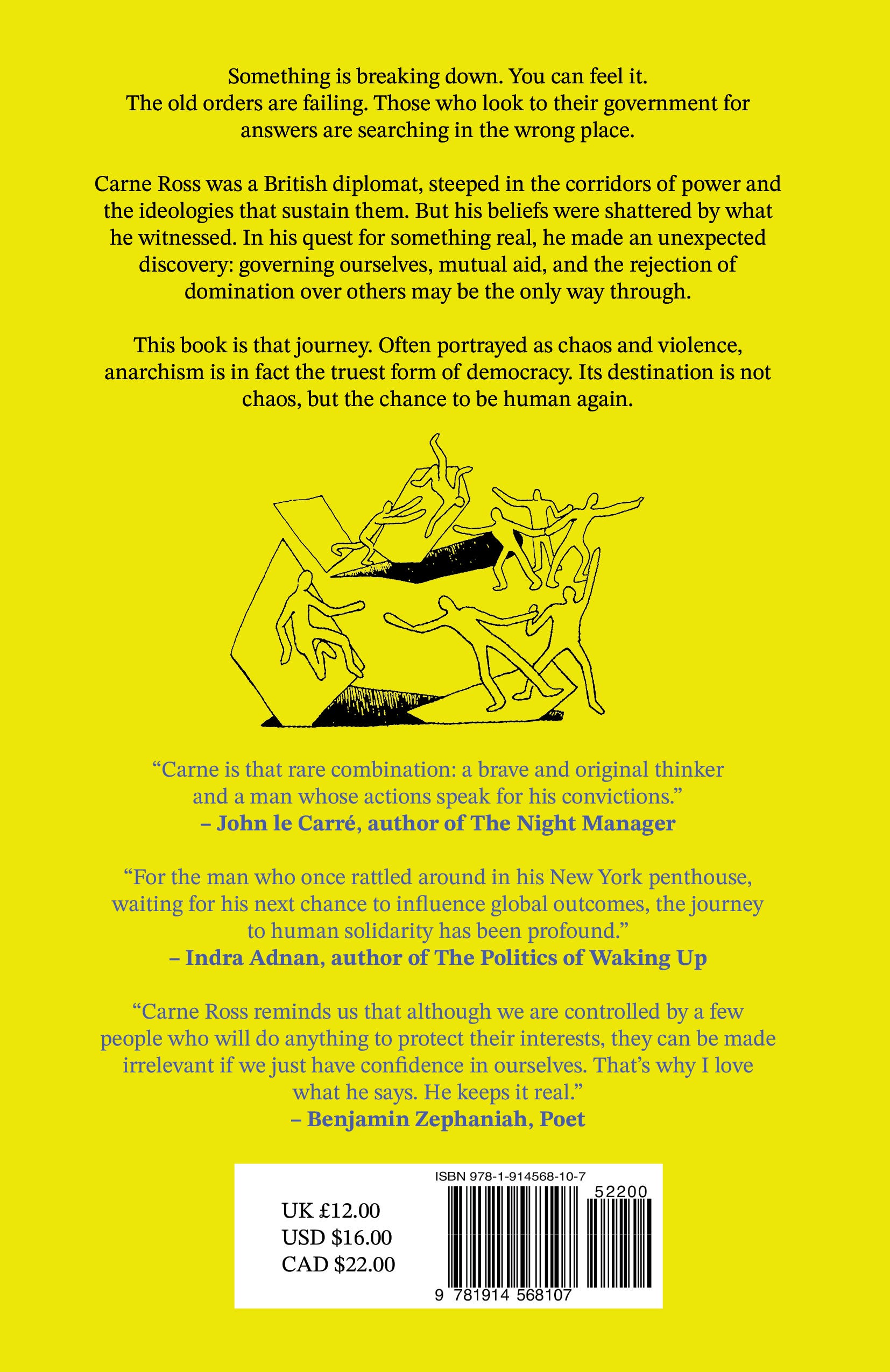
OK, tell me more about the book then.
Well, it’s consistent with prior Perspective publications that combine a personal story of identity formation with a broader intellectual adventure, in the spirit of, for instance, Unlearn, The Entangled Activist and The Politics of Waking Up.
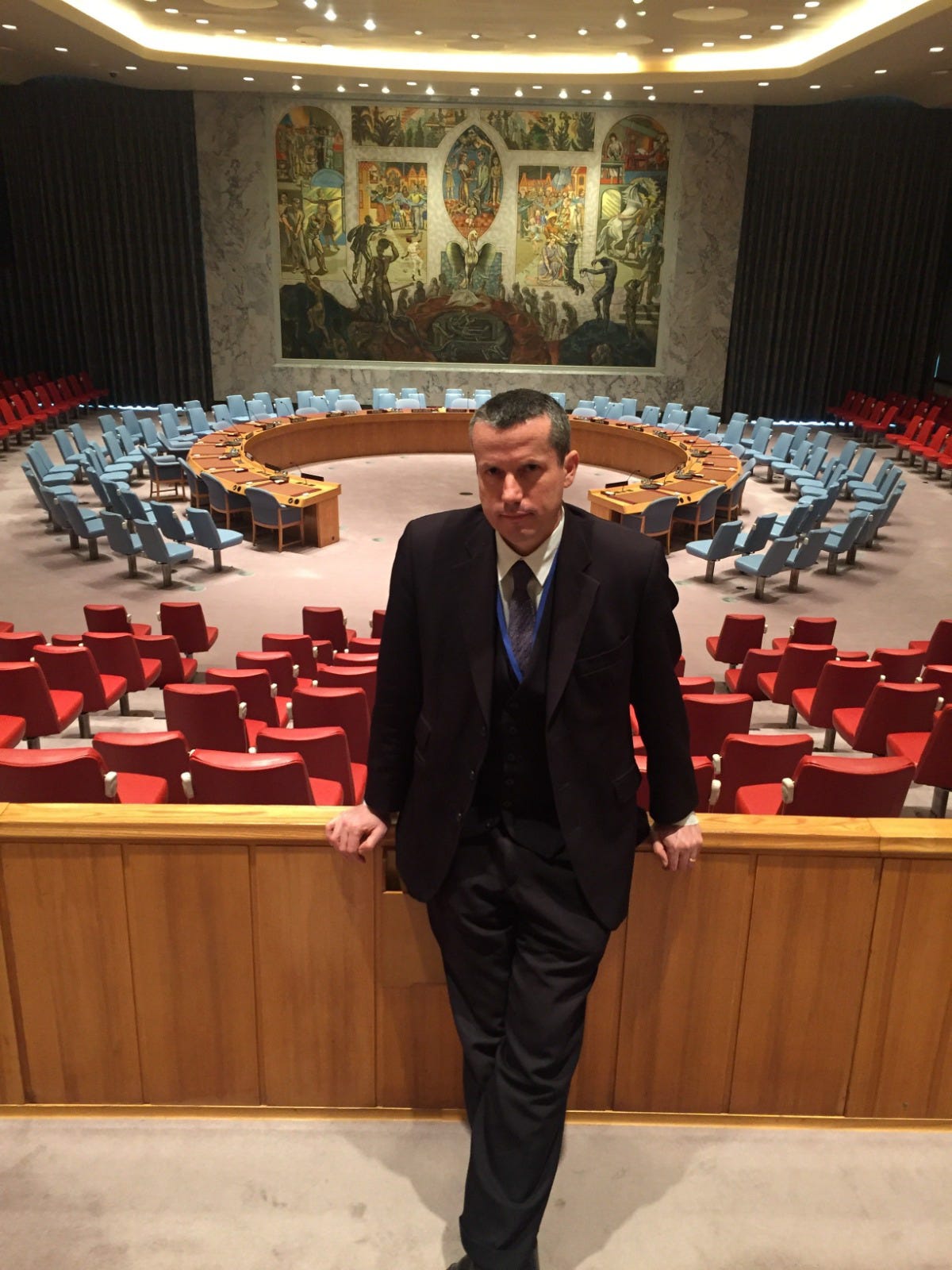
There We Human Again is a memoir of sorts, or perhaps more precisely a non-fiction political bildungsroman, in the sense that it’s about the formation of an identity and worldview and what has been learned along the way. It’s about the construction of the author’s political worldview - his desire to become a diplomat and his experience of acting for the UK government, and then his disillusionment with his own government, the collapse of that worldview, and a complete reconstruction based on his loss of faith not just in his own state, but states in general.
That sounds interesting, but you said it was a book about anarchism.
It very much is, but the book is powerful precisely because the author - Carne Ross - was a consummate state-actor, within the state, for the state, formed by and through and for the state, and so to repudiate the state in the way he does carries conviction and makes the reader pay attention.
How does the book unfold?
Well, some of it is a personal narrative of an experience of transformation, moving from the glamour of statecraft to the challenge of preparing packed lunches for his children while getting his local council to fulfil their obligations. Indeed, in her endorsement, Indra Adnan, who introduced Carne to Perspectiva, says:
For the man who once rattled around in his New York penthouse, waiting for his next chance to influence global outcomes, the journey to human solidarity has been profound.
Some of that story was told in the documentary, The Accidental Anarchist, but this book details the author’s growing understanding and commitment to anarchism.
While reading, I was occasionally reminded of Robert Pirsig in Zen and the Art of Motorcycle Maintenance, because the author shares his inner and outer journey with the reader, moving between them seamlessly, with rich descriptions of places where he has witnessed anarchist-style communities and advised them, for instance, in Rojava. But the best quick answer is to show you the table of contents:
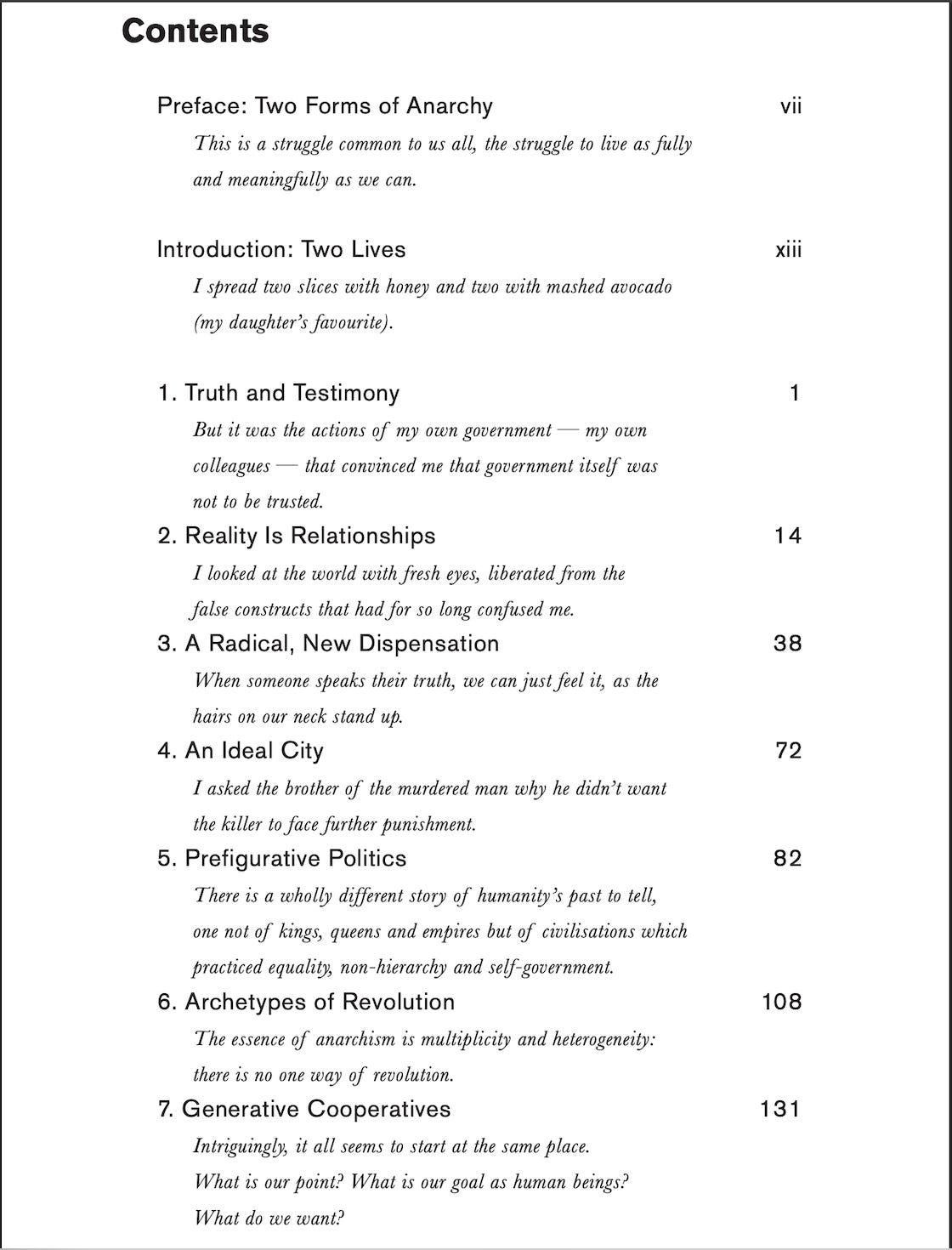
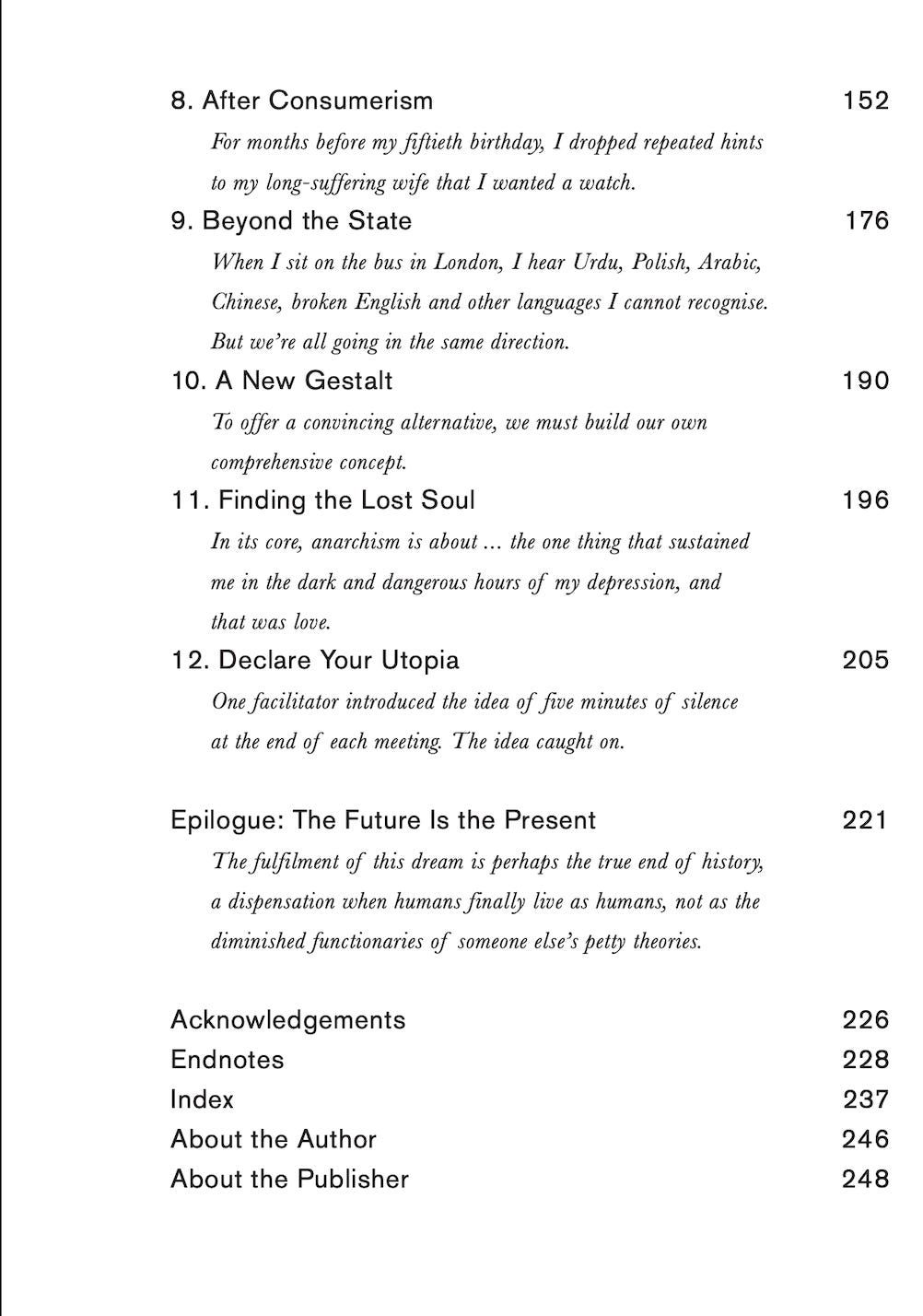
OK, that doesn’t look too shabby. But what’s with the title: There We Are Human Again?
Well, according to the book, the current dispensation of the world is dehumanising in a range of ways, not least loss of political agency, and economic servitude, and so ‘There’ is anarchism: a different way of being, knowing and living.
We considered other titles like Gentle Anarchy, Two Kinds of Anarchy and The Future is Anarchy, but we felt anarchy was too loaded a term for the general reader, and so we preferred to create a curiosity gap, an open question to which anarchism was a possible answer.
Ok, I am beginning to understand why you are doing this. Is there anything else I should know about this book?
Well, in my view it is extremely well written. Carne has authored several previous books and has drafted text at high levels at the UN, and the prose is crisp, compelling, and often very candid. The writing moves between excoriating critique, qualified idealism and personal testimony, including disarming asides like the following:
I too covet ‘nice’ shoes, ‘nice’ coats and, most pathetically, a ‘nice’ computer bag – one that offers both functionality and expresses a style appropriate to my ‘personality’, itself in part a function of a society which puts me in a particular place, a particular status, a particular prescribed depiction of my humanity (what should a white, middle-aged, writer and anarchist wear?).
I have shared a few additional extracts below to give you a flavour of the writing:
It was the actions of my own government – my own colleagues – that convinced me that government itself was not to be trusted.
I now ask myself if I didn’t partly become a diplomat because it was a ready-formed identity, into which I could enclose myself and, zipping myself up, be insulated from the vicissitudes of confronting actual human adult existence.
I had told the Foreign Office that I intended to study the empirical basis of policymaking. Little did they know, little did I know, that this would form my first steps towards anarchy.
Life shouldn’t be about the future. It should be good enough here and now.
Meanwhile, the power we have over the state is slightly greater than zero, but only slightly – a vote every five years. By contrast, the power the government has over us is absolute in almost every aspect of our lives. It’s an absurd and grotesque imbalance. This is what we call ‘democracy’.
Agency is at the heart of our well-being. We cannot enjoy a life of freedom and flourishing without it. As long as there is imposed authority, we are denied the ability to live as we wish or to negotiate our needs directly with other people. There is only one solution: give agency back. What this means is not less democracy, as the fascists threaten, but more.
That sense of inferiority and failure is a product of the system. Most of us feel that we have failed in some fundamental way. Notably, this is an individual mental feeling – we feel it alone. We do not share our shame.
There is a wholly different story of humanity’s past to tell, one not of kings, queens and empires but of civilisations which practised equality, non-hierarchy and self-government.
And here we find ourselves again, back to the same questions. Perhaps at our deepest level we are afraid of losing the religion of capitalism. If we don’t believe in that materialist and horribly logical belief system, what do we believe in?
These anarchists realised that asking others to effect change was futile. It had to come from oneself. And therein lay great liberation and joy.
The essence of anarchism is multiplicity and heterogeneity: there is no one way of revolution.
So the conclusion we’re left with is that the only way to de-centre growth as the ‘point’ of society and indeed government is to shift to a different kind of democracy where everyone is included, delivering different decisions about what matters – social solidarity, justice, provision of basic services to live.
It was a dispiriting exercise of wading through long, over-negotiated and tedious texts, dense with wordy reaffirmations of past agreements and light on actual decisions to do or change anything, and endlessly trying to pep up demoralised and overworked diplomats. Meanwhile, in the real world outside the negotiating chamber, Palestinians were being slaughtered in their tens of thousands in the Gaza Strip; Russian missiles rained down on Ukrainian cities.
I would eat entire packets of chocolate Hobnobs on my way back from the supermarket. I gained thirty pounds.

The attacks on the World Trade Center did indeed transport New Yorkers into a shared and very stark and present reality, where for once we were not individuals selfishly seeking our own goals, obsessing about our own lives, but we were experiencing something extraordinary together. A glib term for this might be ‘bonding experience’, but it was much more than that. It was something more which, of course, I am struggling to put into words. An intensity of being. Something that we could only experience in relationship to one another; it was created together, as we at last encountered ‘the real’. It was beautiful and sad, forged by the sharing of our all-too-tangible experience but also other worldly, ineffable, immeasurable, ethereal…essential. Strangely, I miss it now. I wonder why it took mass death to throw us into that limitless dimension.
As one marketing expert put it to me, people want to buy meaning. The trouble is, of course, that it cannot be bought.
It feels scary and decidedly unfashionable to use words of great ambition and aspiration. But I believe that something magnificent is available, if only we see it, if only we have the courage to build it. A world where we at last can find fulfilment, meaning and purpose, through the practice of intimate cooperation and mutual aid, an environment propitious for that most vital and epic of human needs, wants and joys – love itself, an act not just a feeling. I have no words adequate to convey its gravity or its qualities except to say that it is the most important thing of all.
OK, I am not an anarchist yet, and probably never will be, but I like the sound of the book. When is it out and where can I order it?
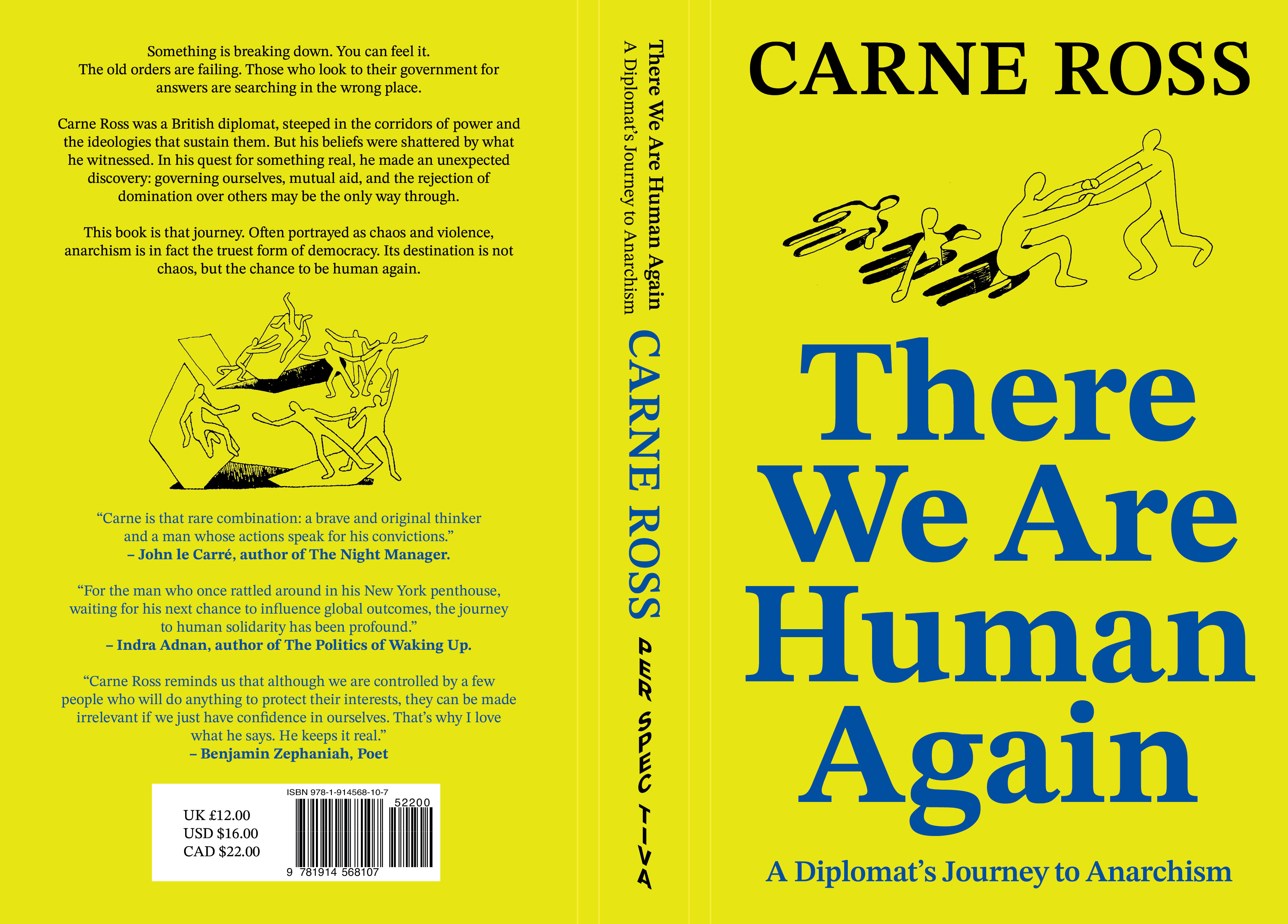
There We Are Human Again: A Diplomat’s Journey to Anarchism is published by Perspectiva Press in the UK on June 9 2026, and in the US on August 11 2026.
We invite and encourage prospective readers to consider buying the book somewhere other than Amazon, though you can do so here. In the US, we suggest you consider pre-ordering at Bookshop.Org. In the UK we are having some technical problems with Bookshop.org so we suggest you consider pre-ordering at Waterstones. If you would like to keep track of news relating to Carne’s book, please see the dedicated page on his website.
**Pre-ordering greatly helps to bring the book to people’s attention, so your support is much appreciated. Thank you!**
I think that this is a generous and thoughtful case for taking anarchism seriously. I appreciate the way you distinguish it from chaos and tie it to cooperation and mutual aid.
What I find myself wondering is whether this vision of cooperation can be sustained if the deeper biological and somatic layers of human life are not properly included. When people are asked to cooperate across increasingly abstract or imposed structures, without strong, lived forms of belonging and boundary at the base, it often seems to require a kind of override—and that override tends to drain vitality over time. Real mutual aid might depend on people having intact, high-trust local roots to begin with, rather than trying to generate cooperation on top of weakened or flattened ones.
How do you see the relationship between anarchism’s suspicion of coercive state power and the need for people to remain rooted in smaller, more embodied forms of order and belonging?
For me, Anarchism isn't about upending the world, but about breaking the Randian consensus that selfishness is the only important human characteristic. What Kropotkin introduced, and has been reinforced by Ostrom and others, is that we are equally (if not more) collaborative and interested in mutual aid.
What Anarchism articulates is that structures of power always attract the worst people, meaning the society takes on the characteristic of the psychopaths and narcissists, not people who would just as soon get along and not consume more than they need. If we cannot get rid of the bad people, we should concentrate on reducing the power we grant them.