

Writing About the Future in Your Eighties.
Beyond Tomorrow: Planning a New Civilisation by Christopher Nye

“The eyes of the future are looking back at us ...praying for us to see beyond our own time.”
— Terry Tempest Williams
In the early summer of 2024, I met Christopher Nye, who had travelled far from his home in what he calls “Geezer Valley”, a retirment community in New Mexico, USA, to attend The Realisation Festival in Dorset. He was eager to talk, and we spoke in the repose between the late afternoon session and dinner, walking the grounds of St Giles House. It felt like one of those conversations that were meant to happen - I was struck by his presence and gravity of purpose. I could not quite put my finger on why, but I felt seen, as if Chris knew what I was trying to do at Perspectiva more generally, and I sensed he was keen to help as far as he could. Chris returned the following year, which is not a small thing for a man who is now in his late eighties. He is one of the many people I think of when I doubt the Perspectiva project, one of the many who ‘gets it’, and I feel grateful that he is cheering me on from afar.
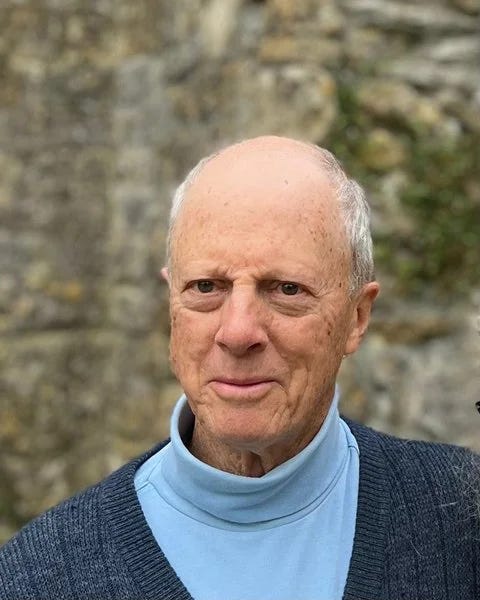
I was glad to read an advanced draft of a book manuscript he’d been preparing, and to write a short blurb for the back.
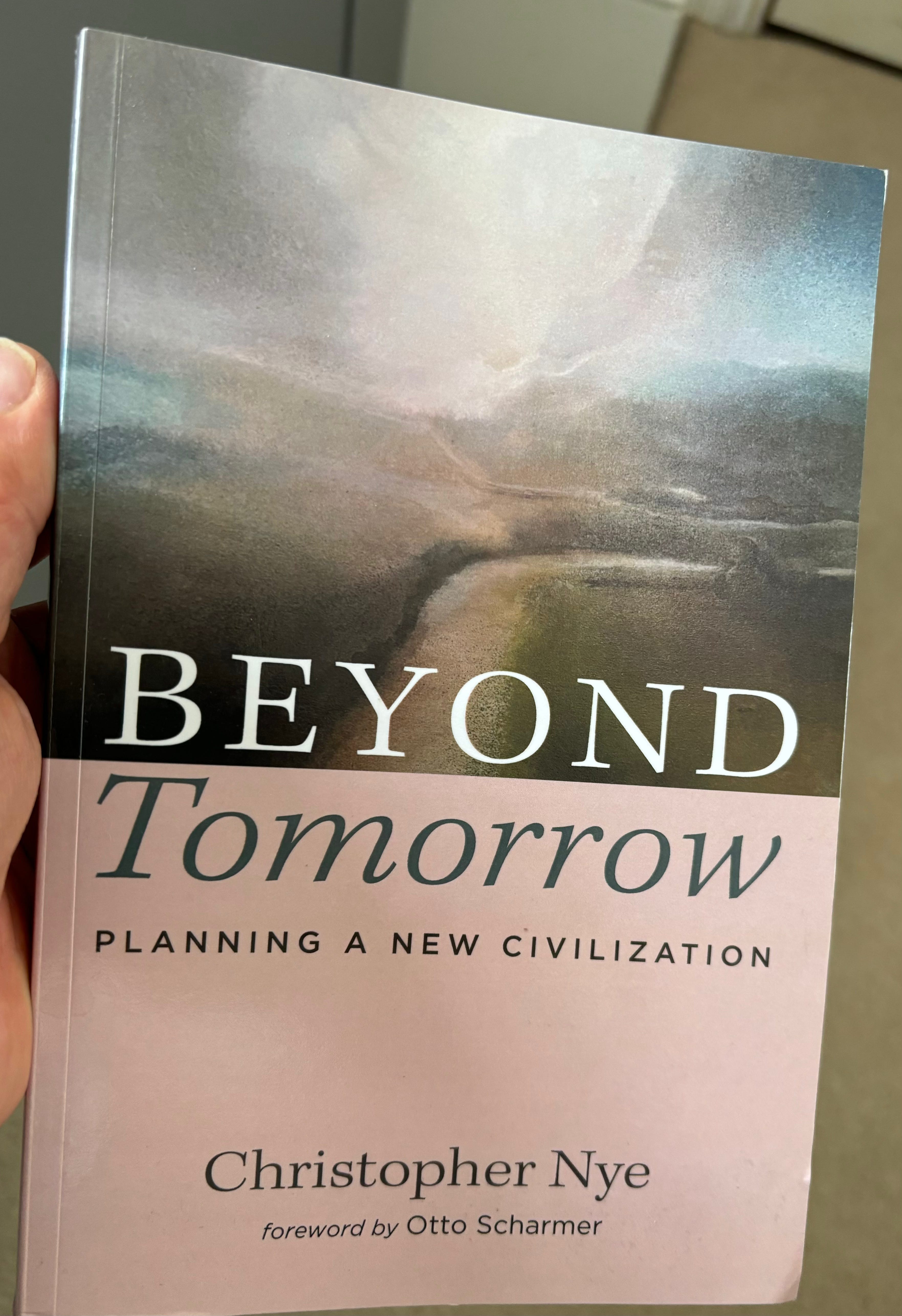
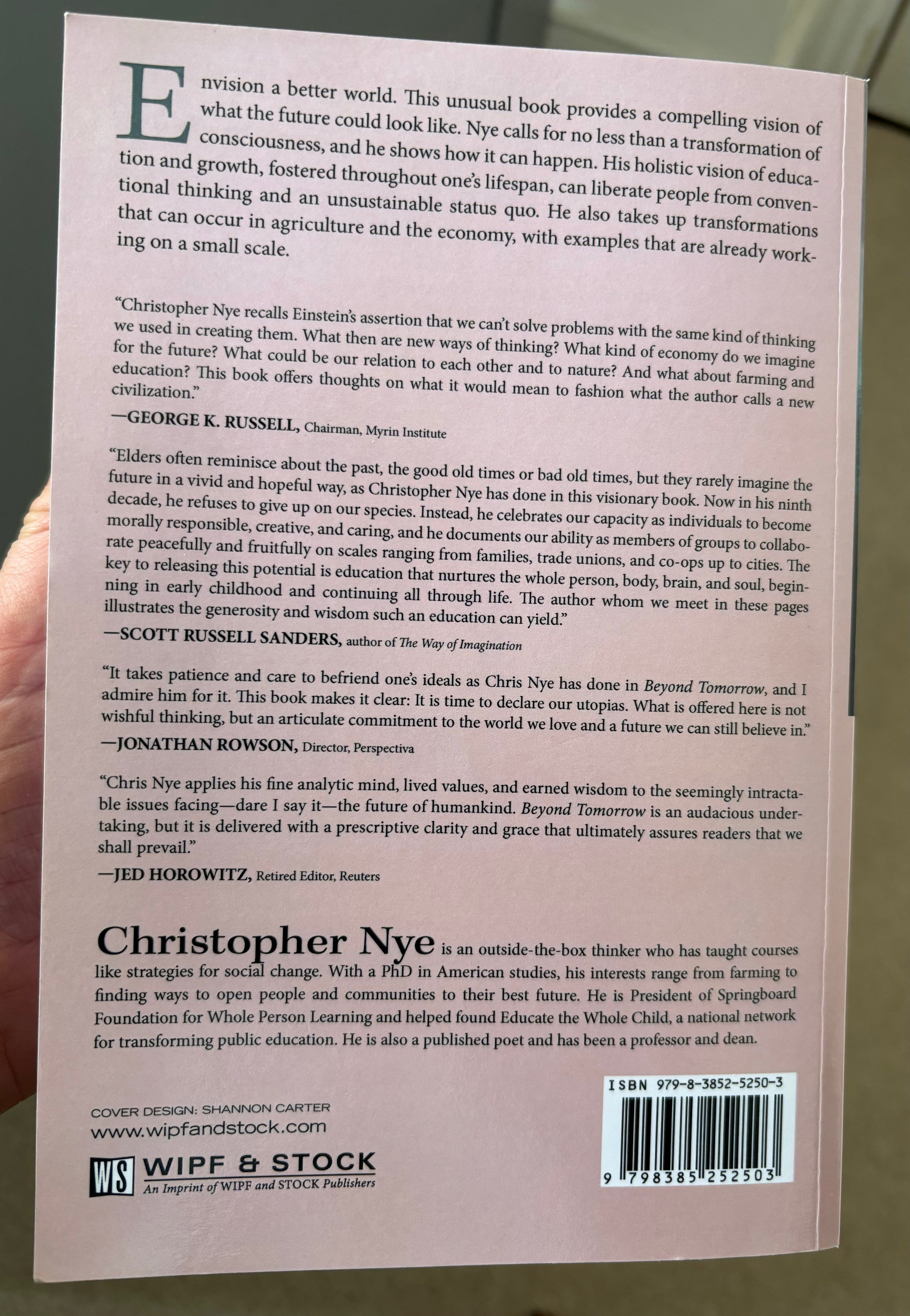
The main thing that struck me was the fundamental premise of an author in his eighties dedicating his time and effort to write a book about the future, laying out the contours of a new civilisation that has learned from the mistakes that this one has made. In the video below, I ask Chris about his motivation and about several other features of the book.
Otto Sharmer writes a good foreword, with an encapsulation of the book at the end:
When systems collapse, we are returned to our relationships, to the land, to one another, and to ourselves. Beyond Tomorrow is not a map but a mirror. It invites each of us to reflect: Where do I stand in relation to the emerging future? What is mine to do now?
I like that Chris’s answer is that what was his to do - even in his advanced years, or perhaps especially because of that - was to write Beyond Tomorrow. He did not write a memoir, or any other kind of backward glance, but a blueprint for what might be needed next.
This mission arises in the context of a life devoted to education, but also a life of near misses and second chances, as outlined in our talk. I was struck by the caprice of it all, including his job as a waiter that only lasted a day, but also the underlying sense of direction and telos. The book features detailed proposals for a new macroeconomy and agriculture, but it is is best understood as a philosophy of education worthy of 21st century challenges, and that is Chris’s professional formation and mission. Chris’s commitment extends to this work includes his role as President of the SpringBoard Foundation for whole person learning, some of which, I am told by their Executive Director, Kam Bellamy, was at least partly informed by my essay on 21st Century Bildung (transformative aesthetic, civil and moral education; or education for the soul) for CUSP, particularly the paragraph right at the end.
This essay has focussed on the why and the what of Bildung, and clearly the how is ‘the work’. In the words of the novelist Haruki Murakami, what is needed is “not words and promises but the steady accumulation of small realities.” In principle, Bildung can happen anywhere at any time, but if we are to take this idea seriously there will have to be a collaborative design process for a growing community of educators, policymakers, artists, and futurists. We have a lot to learn about how to build Bildung today, but that, of course, is the point.
That work is what Perspectiva calls ‘the formation’ - a shift in scale and intensity in the determination of our species to educate itself so that it doesn’t destroy itself. What I like about Chris, and his book, is that he is committed to the formation, but he also gets ‘the flip’ - the need for a shift in collective consciousness, and ‘the fun’, the need to articulate a viable political economy; and then to understand how these three imperatives inform each other. Indeed, Beyond Tomorrow contains aspects of The Flip, The Formation and The Fun.
**
I had some glitches with my lighting in the video that follows, which is why I occassionally look like I’m doing an unbidden yoga posture, holding the screen in place. Other things to look out for include a poem on education near the end, and around the 26 minute mark, where Chris speaks of two major forms of strategy; one of which is built around planning, and the other in increasing our openness and receptivity to help from beyond. I probe him on this idea: does he really mean we can ask spiritual entities to help us?!…
I also like the reference to the tractor and the grand piano brought into the desert to build a new community in Sekem, Egypt. And I love the idea that The Shakers made chairs on the understanding that an angel may sit on them. Chris also has a chapter in the book on the meaning of Convivencia, and, like Robert Pirsig, he’s into chatauquas.
It’s just a chat really, but I hope you enjoy it, and I encourage you to ask yourself what Beyond Tomorrow means to you.
Really interesting and watched the video, I think you have connected with a very interesting man in Christopher, so often the older we get the more we withdraw from society to a “well earned rest”, my father is 88 and enjoys nothing more than sitting round the table with a group of younger people and debating life, Christopher is so rare, a kind of Richard Rohr type, humble but full of ideas and energy, quiet yet carries weight and authority, so inspiring that he is giving his time away for the sake of our world. Especially his time that is so precious in his later years.
Thanks for highlighting Christopher's work. Added to my to read list. Much in common with Dougald Hine, At Work in the Ruins.