


Against the Machine by Paul Kingsnorth is an important book. It compels reading. I have taken the time to write this review essay because the book moved and stimulated me profoundly, more than any other book has done for some time.
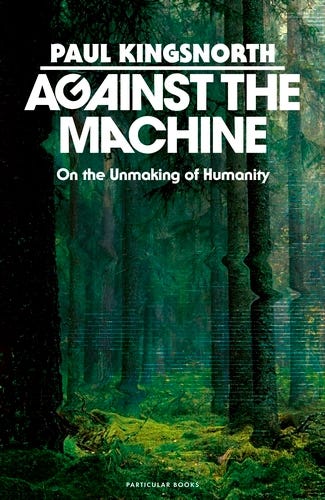
Before I explain the value of the book, let me first say that it is by no means unproblematic. There are aspects of the argument that appear calculated at times to shock, which I reject, and hope others will too.
On p.240, for instance, the author appears to claim that Philip Pullman’s His Dark Materials amounts to a near-satanic call for self-worship. This is a mistaken interpretation. We might sometimes worship each other, in love, as the protagonists of Pullman’s trilogy perhaps do by the end, but that is not at all the same thing as worshipping ourselves. (Editor’s note. See Paul Kingsnorth’s response in the comments.)
Perhaps his being an (Orthodox) Christian also explains why he is, in my view, too hard on the coming of Eastern spirituality to the West. I’m with Sam Harris in thinking that it is just unreasonable, as Westerners, to close ourselves off (as Kingsnorth appears to) to the beautiful wisdoms of Eastern traditions, because those traditions so manifestly contain magnificent practices and understandings that have been less prominent, less available, in our lands. (Editor’s note: again, please see comments).
However, in Against the Machine, Paul Kingsnorth explores with a clarity that is extremely rare the extreme metacrisis that we are now deep in. He turns here his original, scorching, prophetic gaze on the civilisation that produced him, and you, and I — and that is now consuming itself. He does so with trademark literary insight.
Of “the net”/ “the web”, for instance, he remarks:
These things are designed to trap prey.
It’s one of those lines that catches in the throat, or in the cranium: a mini-mindbomb. The internet, that vast, shimmering architecture of promise and control, is not just a metaphorical web: it has turned into an almost-literal snare. In the sway of ‘platform-capitalism’, it holds us fast while we mistake our captivity for connection (think social media).
Kingsnorth’s gift lies in saying such things both provocatively and plainly — in writing that sounds, increasingly, like witness testimony from inside a cage.
We are with virtual certainty headed into collapse events. If and when the internet finally goes down forever, Kingsnorth suggests, we might even celebrate.
But how? What would it mean to dance in the ruins of the digital? Could disconnection become our liberation — or would we already be too attenuated, too ghostlike, to feel it?
The Birth — or Illusion — of Intelligence?
Kingsnorth warns darkly and at length about the rise of artificial intelligence, describing it as a kind of new lifeform “being born.” He has explored this possibility before, most imaginatively in his astounding, vital novel Alexandria, where the post-human perhaps inherits a desecrated world. But here I find myself uneasy. Is something really being born — or is this new world-shaking technology, finally, just smoke and mirrors? A supercharged sentence-completion trick, an immense tautology with no interior?
We are indeed in mortal danger from AI: think disinformation squared, energy use through the roof, human relationships devalued, and much more. But these dangers are perhaps not because it possesses any intelligence at all, let alone wisdom. Rather, because AI simulates intelligence perfectly enough to displace the real thing — to seduce us into ceding thought, care, and responsibility to a machine that feels and thinks nothing.
Are you, I want to ask Kingsnorth, giving the AI-cultists unnecessary oxygen? Some techno-mystics would love the idea that their servers are incubating a super-intelligence. I would rather disabuse them and their audience than pay them a backhanded compliment. Might what is actually “being born” be immeasurably colder than Kingsnorth seems to think: Nothing in particular - the perfect void?
Kingsnorth oddly shares something significant in common here with Vanessa Andreotti. She, too, has recently suggested that something is truly being born, in AI. Only she thinks that what is being born could potentially be as wonderful as Kingsnorth thinks it is satanic. My view is that both are profoundly mistaken. Nothing is being born! The reason we are in as awful trouble as indeed we are, AI-wise, is that we are on the cusp of handing over much of our power to an incomprehensible void which will almost certainly be radically un-alignable with us, simply because there is no there there.
Animism After the End
Kingsnorth wants to counterpose to the coming silicon cults something strong and old. Throughout Against the Machine, then, runs a much more venerable religious current, a return of the ancient idea that everything is alive — the animist sense that the world is breathing spirit at every scale. Like others today who sense that mechanistic materialism has reached its dead end, Kingsnorth gestures toward a re-enchantment of every part of the world. Iain McGilchrist, for instance, calls it “The most powerful and important book I have read in years”.
But… is this truly available to us? Can animism, shattered by centuries of disenchantment, be credibly revived? Is it really a live option for us?
Kingsnorth ends the book with an invitation to readers to perform a “Raindance.” It is a lovely image, but I do wonder if such a thing is available to us except as some kind of artwork or performance. Can a post-industrial people truly dance for rain — and mean it?
I am sceptical of all this. At the very least, I think we’d be better off seeking first to dance just to find out again what dancing (ecstatic connection) really is again - before having a go at anything as non-credible as a raindance!
But even if you disagree with me, I have a deeper question to offer here: Is animism, which is currently becoming ‘fashionable’, even actually desirable at all? There is a potential peril inherent in it. Namely, in saying “everything is alive”, we flatten the radical difference between life and non-life. If rocks and rivers are said to be as alive as foxes and fungi, do we not risk losing what is most fragile, most sacred, most killable in the living world? However alive rocks may be, they can’t be killed.
Perhaps Kingsnorth would respond that one can’t actually imagine an intelligible world shorn of the Holy Spirit. Perhaps such a Christian Animism is indeed what we should be aspiring to. I would respond, though, that regardless of whether a river is ‘really’ alive or not, perhaps, since we are so hopeless at even understanding that foxes/fungi/we (!) are alive, we aren’t ready to hold the idea of rivers and rocks being ‘alive’.
By asking us to consider that everything is alive, perhaps animism today risks obscuring our ecological interrelatedness with everything (including rivers and rocks) at a time when we have barely begun to re-experience this utter interrelatedness as the epic fact it is. Perhaps coming to know that interrelatedness, whilst considering the wild, special, unique aliveness of us and other killable non-things (beings), is a more accessible prompt to care for both the river and the fish in it.
Everything is sacred, yes. But not everything is alive. And what is alive is truly sacred.
Science, scientism, and the new reactionaries
One of the strongest threads in Against the Machine is Kingsnorth’s excoriation of scientism — the ideology that turns science into a religion, a metaphysical creed of control. On this, we are in deep agreement. I have spent much of my own philosophical life warning against the idolisation of science.
Yet timing matters.
Since Kingsnorth went to press, a disturbing trend has accelerated: a turning against science altogether. Climate scientists are being silenced or sacked in the U.S. right now. So when Kingsnorth writes that “Follow the science” is the mantra of our age (p.241) I can’t help but riposte — if only!
We badly need science: on climate, biodiversity, the oceans, and much more. Perhaps scientism is not the heart of the problem, but merely the servant of something deeper: technophilia — the worship of (power and control through) technology. The oligarchs have weaponised science’s prestige while undermining its practice.
We should renounce scientism, the dangerous ideology of science-worship. But in the same breath, shouldn’t we defend science itself — unscientistic science — as one of the glories of our civilisation? Science as curiosity, as wonder, as humble inquiry into the more-than-human world… Perhaps science, too, can be reborn — reoriented toward reverence and protection, not dominance. Consider then ‘unscientistic science’ as something to keep. Curiosity, wonder, humble enquiry into the more-than-human world might not just evoke one of the glories of our civilisation but also be a key expression of who we are - I mean, this ensemble should surely be one of the ways we can carry out our sacred world-witnessing duties.
Kingsnorth sees that scientism has fed authoritarianism. I would add that today it is strength-worship — the fusion of technophilia with demi-fascist politics, wrapped in pseudo-spiritual language — that most threatens us. The machine now wears a mask of destiny. The return of might-based societies threatens us all (including the new mighty, who will end up like Ozymandias). They - the oligarchs and ‘leaders’ - want to make knowledge scarce. A commodity. Facts are a threat to their dominance. They’ve moved past denial and into ‘How can I maximise power and profit in the emerging instability?’. They tend to be less like cultists and more like rich preppers who hoard tools to dominate when the State is dismembered.
Decolonising the self
To understand what is happening adequately (because it is as bewildering as it is horrendous), a long view is helpful. This is why and how Kingsnorth’s historical vision is as needed as it is bracing. In his superlatively linguistically-innovative novel The Wake he gave us the Norman colonisation of England as psychic trauma, a collapse both material and inner. In Against the Machine the colonisers are very deep within: not just our elites, but our own hyper-left-brain logic, our addiction to control (which self-undermines). The machines are simply the latest invaders, completing a process of self-colonisation that began long ago.
How, then, do we truly decolonise ourselves? Can we derive meaning precisely from the extremity of our predicament? Our backs are against the wall; yet from that very pressure might come purpose. In facing annihilation, perhaps we really do glimpse the sacredness of what remains. I have argued elsewhere (e.g. in Why climate breakdown matters) that we can, must and will make meaning from crisis — that the path through nihilism lies in the courage to inhabit our peril consciously.
In that endeavour, Against the Machine is an ally. As Rebecca Solnit, for instance, has also explored brilliantly in her most important book, A Paradise Built in Hell, I think that when we take in the extent to which we may gain succour from our travail; breakthrough from disasters and love and energy from our very suffering, then we can entitle ourselves to a big dollop more of active hope than Kingsnorth’s book seems to suggest. And the beauty of it is that true, radical hope will come from tenderness.
For the difficult emotions, such as grief, are nothing if not an expression of that: of ruptured living, loving-care.
I fear that Kingsnorth’s book is at times too full of fear and anger, and not given enough to grief, shame, curiosity, awe, and love.
Against ‘Development’. Against the Binary.
A way of putting the worries I have been expressing above is this: I fear that Kingsnorth’s book is at times too full of fear and anger, and not given enough to grief, shame, curiosity, awe, and love. But let me also be clear: there is a lot to be afraid of and angry about…and Against the Machine mobilises such emotive critique quite splendidly.
Kingsnorth’s book denounces the myth of progress, the skewering of which is a huge world of pain that our century will endure. And his critique of “development” is devastating. The word still rings as a moral good in polite society, yet what it means in practice is global North hegemony, the erasure of local autonomy, the subjugation of living communities to a technocratically-inflected version of ‘the market’. How do we help people see that “development” is, on balance, a horror, not a blessing? By showing its ties to domination and ecological death? Or must something still more radical be imagined — a post-developmentality relocalised civilisation (s) of restraint and reverence?
Early in the book, Kingsnorth marvellously reclaims ‘Luddism’ from those who have turned it into an insult. The Luddites were not mindless vandals; they were intelligent, deliberate (as well as desperate) critics of the thoughtless implementation of tech in the name of profit. Put thus, we could surely do with some Luddism to counter the oligarchs of our own age, who are becoming quite insanely rich by trying to persuade us that ‘there is no alternative’ to the onward rush of the machine.
Then, on p.81, Kingsnorth executes a marvellous gambit: he turns on its head the widespread nostrum that the city is open to thought and openness itself, while the countryside is narrow and blinkered. He points out that the inherent parochialism of city-centrism is its human parochialism, its inherent narcissistic direction. We dwellers in the countryside are far more likely to sense - because we see it every day - our being part of something bigger, a web of life. It is in the city that one gets tempted to an anthropocentric vision that fantasises self-sufficient machine dreams.
When we truly think about all this, then, as Bruno Latour’s final works showed, we think something orthogonal to what our current politics still insists upon. For we then think outside the hegemony of Growthism. Part of what makes Against the Machine so potent is its refusal of the Left/Right binary. Instead, we find ourselves, Kingsnorth says, possibly in an echo of Hannah Arendt, “On Earth, under the sky.” (p.156). The phrase encapsulates a politics of rootedness beyond ideology. The right blames the left; the left blames the right. Both miss the machine. Perhaps anti-machinism — life against mechanism — could itself offer a new basis for solidarity, even spirituality, in the difficult age into which we are moving.
Perhaps anti-machinism — life against mechanism — could itself offer a new basis for solidarity, even spirituality, in the difficult age into which we are moving.
Kingsnorth rightly praises Simone Weil’s little-known yet seminal work of political philosophy (commissioned by de Gaulle, no less, during the Second World War), The need for roots. We might, as Simone Weil urged, seek roots instead of abstractions; belonging rather than ‘progress’; coherence rather than cosmopolitanism. There is the germ of an encouraging alternative (to the myths by which we are possessed) here: a politics of place and limits, grounded in the living earth itself. Moreover, if this is right, then it’s urgent that we (the sane silent majority, including both non-machine-addicted-‘progressives’ and genuine conservatives) share and take seriously such ideas and experiences of belonging and rootedness… before the far right squeezes the potential for love out of them and we lose heart (not to mention, our very country).
And Kingsnorth is right (p.153) that taking community and belonging 1000% seriously need have nothing whatsoever to do with fascism or Nazism; as I say, by contrast, it is the very bulwark against them.
Fascism rises when the way is cleared for ‘the machine’ by way of uprootingly destructive left-liberal ideology. In particular, there is virtually no ‘eco-fascism’ at all; the term is primarily used by Modernist environmentalists to try to police the zone: to make it rationalistic and technophilic, and to keep the truth of limits (including, crucially, planetary boundaries) at bay. Thus, every time you hear someone running together the very real spectre of fascism with the kind of reclamation of roots and of the regional or local practised and preached by (say) Chris Smaje, or Helena Norberg-Hodge, you are hearing the voice of the machine, in an ‘environmentalist’ guise.
Liberation?
I’m with Kingsnorth not just in his critique of ‘progress’, but also his critique of the damaging effects of hegemonic liberal-individualist ideology (especially p.172.). I do worry, though, that perhaps a little like his (and my) mentor McGilchrist, at times Kingsnorth is insufficiently open to the possibility that we could actually get somewhere on the deeply concerning matters by organising together. When he was young, he believed in the potential of mass movements, not just of lone against-the-grain writers. Might there be some way to unify his younger and older self in this regard? In my view, that would be a very good thing!
To illustrate this concern, let me note that there are moments where Kingsnorth’s challenge to “liberation” strikes me as too sweeping. True, the word has been hollowed out by consumer culture — “freedom” reduced to choosing your brand of cola / of slavery. Yet I wonder if we might reclaim the term. Liberation, rightly understood, must be relational: autonomy that deepens interdependence, not denies it. Freedom for and with one another, not freedom from one another.
Our machine dependencies — from fossil fuels to algorithms — have steadily stripped us of such real freedom. To be liberated now might mean to start to relearn how to live without the machine’s prosthetics. To be dependent only on life itself. Which means: on each other. Autonomy is relationality. And here the good news is twofold: firstly, that mass movements (Think XR, and perhaps in times to come the CMP, or bioregionalism, or indeed Mayor Mamdani) can initiate change by bringing people into relationship with each other; and secondly, that community is precisely what humans hunger for. Now more than ever, in its absence. There is a growing hunger to learn how to be in community as well as to experience it. Freedom to earn ease, rather than the ‘freedom’ to ‘choose’ from one dis-ease or another.
I’m thinking of what I hear time and again (including from people who wouldn’t touch ‘activism’ with a barge pole) as I give talks around the country on climate adaptation and resilience-building. I’m thinking (more locally) of things like the community orchard recently co-created in my village; over 10% of the entire village turned out to plant it. I’m thinking of the annual wassailing we enjoy there, very lightly-held and unmetaphysically intended. I’m thinking of our ‘5-mile network’, which seeks to co-design a bit of local resilience. I’m thinking of the celebrations of the winter solstice upcoming here, around open fires.
Kingsnorth is dead right (p.182), in my view, to celebrate the humble open fire as nothing less than an enduringly essential part of what it is to be human. Most of us in the end want nothing more than to sit around one, relearning how to be together.
Dancing in the ruins
I find enormous potential encouragement in the confidence that there is a return of community and indeed of the spiritual or religious coming, because, in really hard times, that is simply what happens.
What is returning needs to be an ecospirituality. A non-dual approach to existence: a return of the sacred in which to venerate the sacred is completely compatible with loving life, being fully present to the moment in its quotidian materiality.
Kingsnorth’s book is, finally, not merely a jeremiad but an invitation. It calls us to remember what it is to be human — to live as co-conscious creatures, not as machines. Yet it also leaves the reader haunted. If the web was designed to trap prey, then our task may be to outlast it: to wait, patiently, for the day when the network falters, and the old songs can be sung again.
When that day comes, when the screens finally go dark, when you can no longer read essays like this online but only (if at all) in glorious paper, perhaps we will meet each other under the open sky. And perhaps, as Kingsnorth suggests, we will dance — not for rain, certainly not for ‘progress’, but simply to be alive. For the joy of it.*
*Big thanks to Charles Hampton, Alex Haxeltine and Alison Seddon for comments that have improved this essay. Thanks also to Richard Delevan for essential conversations on related themes.
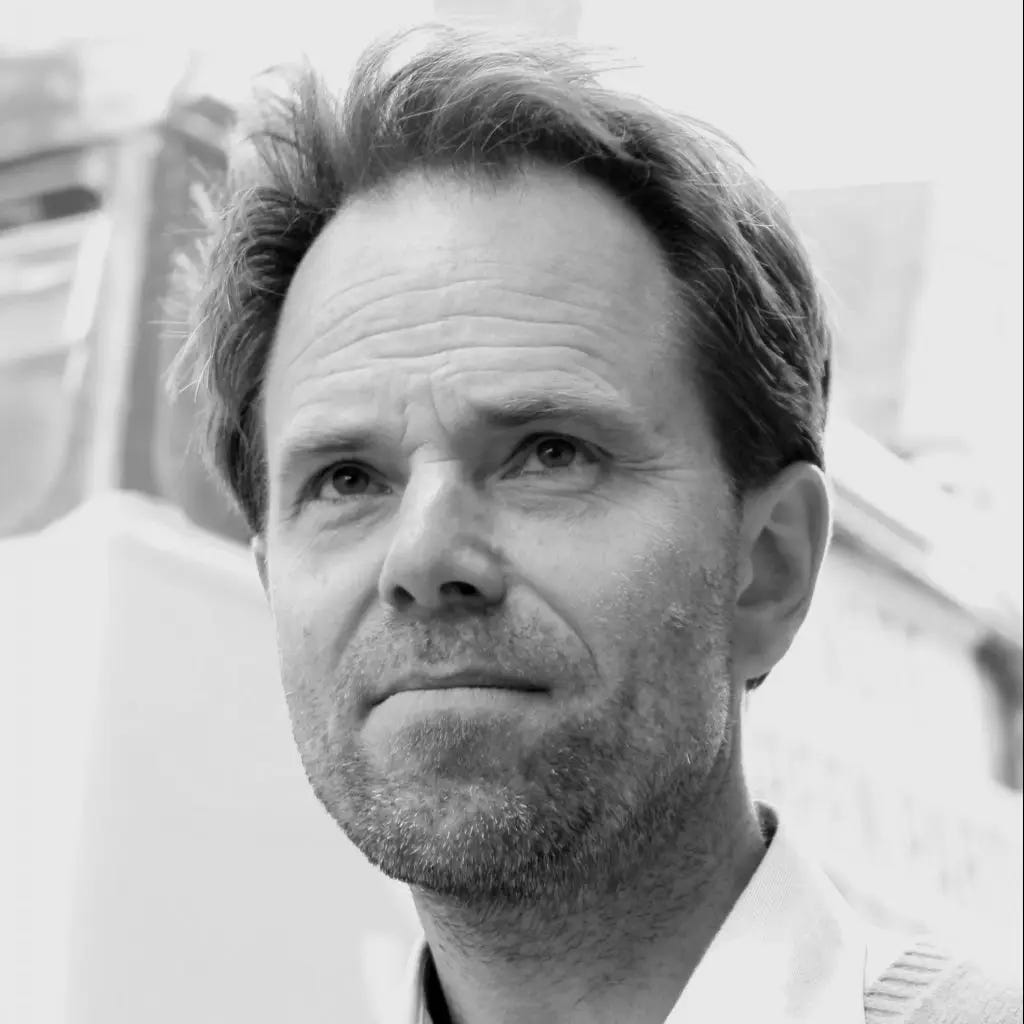
Prof. Emeritus Rupert Read is an environmental philosopher, public intellectual, and the founder and current director of the Climate Majority Project. He is the author of the books This Civilisation is Finished, Parents for a Future, Do You Want to Know the Truth?: The Surprising Rewards of Climate Honesty, Transformative Adaptation, and many more. He has in the past served as a spokesperson and strategist for Extinction Rebellion, a Green Party councillor, and a Green Party MP candidate.

I appreciate the review and the work put in, Rupert. I'm sorry we didn't get to discuss this in person.
There are a few things I could quibble about here but I won't. I don't think all of your interpretations of the book are quite right, but people would need to read it to decide for themselves.
There are a couple of clear errors though, which are worth correcting:
'Philip Pullman’s His Dark Materials amounts to a near-satanic call for self-worship.'
This isn't what I said. I wrote that Pullman's series is a work which deliberately sets Lucifer up as the hero and God as the villain. This is the case, and Pullman has acknoweleged it himself. In that sense, the book is openly Satanic, in the literal sense. Pullman, of course, is an atheist so he doesn't believe in Satan.
'[Paul] refers to queerness as “the greatest sin in the Christian world”.'
No I don't, and this is a bad misreading. I refer to *pride* as the greatest sin - which it is. The foremost of the seven deadly sins, in fact, and for good reason. Pride leads to the kind of self-worship I critique throughout the book.
As I say, we will disagree on other things - science and AI, for example - but then half the point of the book is to provoke this kind of discussion. So thanks again for it.
Even as we understand we must move beyond binaries, it is so hard to see how they structure those very attempts. We still end up with life vs machine, or life vs non life. How to break this or to begin to understand that these are not two ends of any spectrum? That there is no line, that whatever is, it is more kaleidoscopic and constellatory than we even have symbols for yet?
This is a truly dissonant and earth changing chance!
In my discussion with you (and also in the one with McGilchrist), we practiced how to hold this space so as to extend beyond polarities and better receive this full constellation, and this essay (like so much of your philosophical work, as we discussed) is another practice of love in that sense. Still, it is gripped, held in the jaws of, constrained with, that same clench of either/or.
So plase hear (read) this as a call from an emotional heart struggling to articulate what I can feel here but is never quite expressed. For example, when you write:
"Kingsnorth oddly shares something significant in common here with Vanessa Andreotti. She, too, has recently suggested that something is truly being born, in AI. Only she thinks that what is being born could potentially be as wonderful as Kingsnorth thinks it is satanic. My view is that both are profoundly mistaken. Nothing is being born!"
This is such an important point and I've seen so few notice or make it, and yet, of course something is being born and it is what was never born and will never die and yet is shaped by both these 'sides' which are actually two points in a larger constellation that we need somehow to be able to discuss and hold together. Think how very many ideas (dare i even say opinions or even beliefs) Kingsnorth 'on his side' and Andreotti 'on her side' have sparked for good caring people and how many of those will assume whichever of those views is 'right' and thus will feel compelled to share and support and endorse and find further associations through that lens. Isn't this birth of the sort that is actually transformation of the world? Isn't it why both are so exciting? And so meaningful? How to acknowledge your point and also to hold that there is continual birthing?
Another example is when you write:
"in saying “everything is alive”, we flatten the radical difference between life and non-life. If rocks and rivers are said to be as alive as foxes and fungi, do we not risk losing what is most fragile, most sacred, most killable in the living world? However alive rocks may be, they can’t be killed."
Again, such an important and not often made point, and also touching on arguments that come up constantly in my fields of philosophy and neuroscience. But do you see how the either/or of life and non-life stealthily structure and orient the entire point and all that can be grasped from it? How do we understand the sacredness of what is as existing differently from different positions such that we must express and assess anew each encounter? Rather than coming to life as if we decide if it is life or non-life and then follow the playbook from there? Saying everything is alive excites people because it allows them to feel the magical quality always there in existence and in our ability to be aware of existence and this feeling does dull once one takes a side (i.e. panpsychism or animism) and then has to fit everything and orient everything into it. What if we understood that those isms are tools we use anew in each assessment (alongside materialism, idealism and all the rest) so as to remember the magical quality that is that we are here at all? Then the rock is also a way into that love? And that it need not be killable to open that portal.