

The Failure to Pause
Simone Weil on the Iliad, attention as an antidote to force, and the metaphysics of the interval.

Force collapses time into impulse and action. And this is where attention, Weil’s great counterweight to force, enters the picture. Attention is not simply noticing. Where force compresses, attention reintroduces duration, hesitation, and moral space. The two are structurally opposed. Force makes persons into things. Attention restores the reality of persons. For Weil, this is close to a spiritual act, a form of grace.
Editor’s note: I came across the following essay by Jonathan Boymal about Simone Weil’s reading of the Iliad while browsing on Substack Notes, and was struck by its acuity and enduring relevance. It is shared here with Jonathan’s permission, and he has many similarly thoughtful essays on his Substack, The Last Analogue.
I have heard of Simone Weil, and I know she wrote The Need for Roots, and that she cared about attention, but I have never really read her. And I have, of course, heard of The Iliad. I know it is a foundational text of Western civilisation from around the 8th century BCE that gave us many of our Gods, heroes and archetypes; that is shaped Greek and therefore also Roman culture. However, all I really know is some of the characters and a few of the passages. I have never actually read it (or listened to it), and I suspect that’s because I was never in an educational institution that insisted that I do so. Since it stemmed from oral traditions, I plan to listen to it over the next few weeks. Better late than never!
Jonathan’s essay has a particular take on force, attention, and the interval - a critical human capacity to pause - that education provides, but what struck me more was this notion that force has its own kind of reality that is apparently independent of our own. While it depends on where you draw your lines, the Iliad was pre-axial age, before the transformation of consciousness at scale that gave birth to the kinds of minds we now have, with - at least so it seems - interiority, rationality, selfhood, a notion of God, - a world that is in some sense from the inside-out, rather than the outside-in.
While it’s a little beyond this post’s scope and my capacity on this Friday morning, considering pre-axial thought is valuable at a time when some feel we are entering a new axial age. The essay made me think of Jean Gebser’s Integral structure of consciousness as arising (or ‘irupting’) after the deficient mental-rational mode reintegrates the earlier magic and mythic phases of the kind intimated in the Iliad, and also Owen Barfield’s notion of final participation, as the reintegration of the kind of ‘original participation’ that is disclosed in the Iliad. The question of whether feelings, forces, and meanings are generated within us or arrive from without, or whether that distinction itself is a living question. The Homeric world is outside-in almost entirely. Modern Western consciousness is inside-out almost entirely. Barfield’s final participation, Gebser’s integral structure (and perhaps also Aurobindo’s supramental consciousness) are attempts to imagine what it would mean to hold both simultaneously and consciously. The essay below highlights that our challenge is to know when to pause and how to attend. But I think we should also consider what follows from a deeper reckoning with the possibility that our consciousness, the relational process that shapes our experience of life, is perhaps inherently inside-out and outside-in. The deeper challenge is to become one with the world while still being ourselves.
To bring this down to earth, if you’ve ever been part of an escalating argument where you wonder why it became so enflamed, or overtaken by a mood when you can’t quite place why you are feeling, for instance sad, it’s worth reflecting on what’s going on - whether such feelings are entirely things inside us, matters of neurochemistry and embodiment, or whether they (also) have a different kind of reality that can in some sense possess us. This point applies more generally, but it is wonderfully articulated with respect to force in the essay below.
Jonathan Rowson, CEO of Perspectiva.
What Force Makes of Us, by Jonathan Boymal
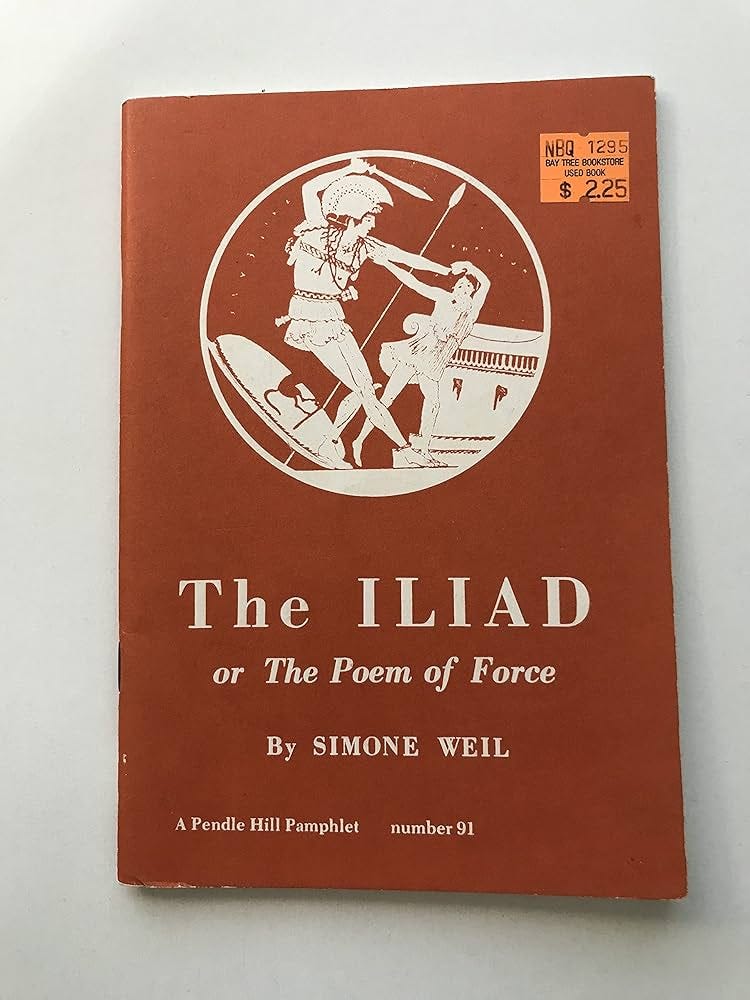
There is a sentence Simone Weil wrote during the fall of France in 1940, that continues to be true:
Force is as pitiless to the man who possesses it, or thinks he does, as it is to its victims; the second it crushes, the first it intoxicates.
She wrote the 24-page essay as literary criticism, an essay on Homer’s Iliad. It is a poem nearly three thousand years old and yet the sentence lands like a headline from this morning.
Before we explore the essay itself, it is worth considering the conditions of its composition. Weil, a philosopher, mystic, and labour activist, who was subject to the anti-Jewish laws under Vichy France that cost her her teaching position in 1940, published the essay under a pseudonym, Emile Novis, in a Marseilles literary monthly. She never mentions the war that is happening, but writes about Achilles and Hector instead.
By refusing to name the contemporary catastrophe, Weil allows the reader to understand it as the latest recurrence of something ancient, something that cannot be defeated by winning a particular war, because it is located in force itself.
Her central claim arrives in the essay’s very first paragraph:
The true hero, the true subject, the center of the Iliad is force. Force employed by man, force that enslaves man, force before which man’s flesh shrinks away.
Weil is not simply relocating force from the divine order into human relationships. She suggests that what appears as human agency is already governed by an impersonal logic.
Weil defines force as
that x that turns anybody who is subjected to it into a thing. Exercised to the limit, it turns man into a thing in the most literal sense: it makes a corpse out of him.
A corpse is the most obvious case: the soldier who was a man and is now an obstacle on a battlefield. But Weil’s real interest is in the subtler transformations. Force can reduce a person to a thing while they are still breathing. The slave whose will has been extinguished. The refugee who moves through the world unseen:
The man who knows himself weaker than another is more alone in the heart of a city than a man lost in the desert.
Weil insists that this dehumanisation is symmetrical. It afflicts the powerful just as surely as it afflicts the powerless. The man who holds the sword does not escape force; he is intoxicated by it. He loses the capacity for reflection, for mercy:
The man who is the possessor of force seems to walk through a non-resistant element; in the human substance that surrounds him nothing has the power to interpose, between the impulse and the act, the tiny interval that is reflection. Where there is no room for reflection, there is none either for justice or prudence.
This symmetry is important to understand. Weil is not ignoring moral responsibility or suggesting that the oppressor suffers as much as the oppressed. She is describing something more specific: a shared ontological degradation. The powerful are diminished as thinking beings.
The interval of reflection, that small gap between impulse and action in which a human being actually lives, is precisely what force destroys in the one who wields it.
Force collapses time into impulse and action. And this is where attention, Weil’s great counterweight to force, enters the picture. Attention is not simply noticing. Where force compresses, attention reintroduces duration, hesitation, and moral space. The two are structurally opposed. Force makes persons into things. Attention restores the reality of persons. For Weil, this is close to a spiritual act, a form of grace.
The Iliad does not celebrate victory. It depicts how victory carries within it the seeds of its own reversal. The warrior who triumphs today will be humiliated tomorrow. Zeus holds out his scales, and the balance shifts.
Power, in this reading, is never truly possessed. It is temporarily inhabited. It passes through people, using them as vessels, discarding them when the conditions that sustained it shift. Those who mistake the temporary for the permanent, who count on force too much are, as Weil writes, destroyed by that counting.
Those that have force on loan from fate count on it too much and are destroyed.
And from Homer himself, as Weil translates him:
Two casks are placed before Zeus’s doorsill; Containing the gifts he gives, the bad in one, the good in the other; The man to whom he gives baneful gifts, he exposes to outrage; A frightful need drives across the divine earth; He is a wanderer, and gets no respect from gods or men.
Zeus’s two urns are Homer’s refusal of moral accounting. Fate distributes suffering and power arbitrarily.
There are no winners in the Iliad, only people who have not yet lost. But Weil’s claim is sharper than temporality alone suggests. What is easy to miss is that this reversal is a consequence of what force does to perception. The intoxicated man cannot see clearly and because he cannot see clearly, he cannot hold what he has won.
Heroes quake like everybody else.
Even Achilles, even the greatest of warriors, knows fear. The alternative, the idea that some men are truly beyond fear, is the lie that makes war glamorous.
What distinguishes Homer from almost every other war literature, she argues, is his refusal to take sides: his willingness to mourn the Trojans and the Greeks alike, the victors and the vanquished with equal tenderness. There is an equity of suffering in the poem. And she notes that Homer “individualised the holocaust of war by having each man die to his own simile.” Each soldier’s death is given its own image, its own metaphor, its own music. The apparently uniform slaughter of thousands is revealed as the incalculable sum of individual losses.
This is what she holds up against force: attention. The willingness to see the other person as a person, even in the midst of a war, even when seeing them costs you something.
For Weil, this also has a theological register she never entirely separates from the analysis. Force is what empties the world of the good, or, in her language, of God. Attention is the movement in the opposite direction. Whether or not you share her religious horizon, something important is lost if you read her only as a social critic. The stakes, for Weil, are metaphysical. Force is a permanent feature of human existence under conditions of power. War is the clearest expression of a general condition. Peaceful systems often conceal force rather than eliminate it.
Which is what makes this framework so unsettling when you hold it up to the present. Wherever force operates at scale (economic, political, social) it transforms everyone it touches. It intoxicates those who hold it. It crushes those who don’t. The boardroom as much as the battlefield. The institution as much as the army. Consider the algorithm that routes a welfare decision without a human pause between input and outcome. Or consider Minab, Iran, earlier this year, where a girls’ elementary school was coded as a military target. The interval of reflection is deliberately absent, and persons on both sides of those decisions are, in Weil’s sense, already partially turned into things: one by the decision, one by the conditions that produced it.
None of this is fixable by better institutions or kinder leadership, though both matter. It is what happens when the interval disappears.
The mechanism by which the interval disappears does not require monsters. Primo Levi, writing from his own encounter with industrial evil, observed that the truly dangerous figures are the common ones, the functionaries who act without asking questions. Hannah Arendt called this thoughtlessness: the failure to pause, to step back, to think. What Weil describes as the intoxication of force, Arendt recognised in its bureaucratic form, the ordinary person who processes, categorises, and moves on, never once allowing the reality of another person to interrupt the workflow. The interval is eroded by people doing their jobs.
This is, I think, where education becomes most charged as a concept. If force is what eliminates the interval, then education is one of the few practices that could be explicitly devoted to restoring it. To teach well is to create the conditions in which a person can be “startled back into thought,” and reconsider. It is the cultivation of the interval as a habit of being, as a form of resistance to what force, in all its registers, is always trying to close down.
The interval is what makes us human. Protecting it is what education is for, even if education itself is not immune to the forces that would close it down.
Weil wrote her essay in 1940. It remains true.

Jonathan Boymal is an Associate Professor of Economics in the College of Business and Law at RMIT University in Melbourne. He has had 28 years higher education leadership experience in Melbourne, Singapore, Vietnam and Hong Kong. Over the last year, he has written a collection of essays for his Substack, The Last Analogue, exploring what it means to think, learn, and become in an age of algorithmic acceleration, particularly in the context of higher education. Ranging across philosophy of mind, psychology, education theory, cognitive science, the ethics of artificial intelligence, film and literature, his central preoccupations include the contested boundaries between human and machine cognition, and the question of whether the habits of mind that made us who we are can survive the environments we are building. The Last Analogue takes its name from a stubborn conviction: that some things about human experience resist digital translation.
 | A guest post by
|
What strikes me reading this is how a 3,000-year-old text can feel less like a relic of the past and more like a companion for the future.
Jeremy Johnson often writes about regeneration not as invention, but as the recovery of capacities that belong to our deepest histories. Reading Weil through the Iliad, I found myself wondering whether the "interval" she describes is one of those capacities: the tiny space between impulse and action, the pause in which force does not immediately possess us.
Cynthia Bourgeault has said that attention is the new power. Weil seems to suggest that attention restores the interval that force collapses. And perhaps this is also what education, contemplative practice, and even relational practices are for: cultivating our capacity to remain present with the denying force without immediately reacting to it.
The past is here. The future is here too. Perhaps both arrive in that interval, in the pause where something genuinely new can emerge.
I wonder whether our task is not simply to speed up adaptation to the future, but to recover and cultivate the intervals that allow us to become human together.
Thank you for sharing Jonathan Boymal's powerful essay.
Love this. Thank you Jonathan.